

Some names feel like a lantern flickering on a foggy road. If you’re searching for names that mean lost soul, you probably want that feeling: mystery, wandering, and a story that never quite ends. Maybe you’re naming a baby, building a character, or choosing a pen name that sounds like it has a past.
This guide gathers 300+ names that mean lost soul, each with its origin and one real detail from myth, literature, or history. You’ll find boy, girl and unisex picks, Japanese and multilingual options, gothic surnames, and clearly labeled fantasy coinages. Every name appears only once, so you won’t scroll past repeats.
Quick Answer: No common baby name literally means “lost soul.” The closest are Perdita (“lost”), Diggory (“lost one”) and Psyche (“soul”). Names that mean lost soul usually work through story, like Orpheus, Persephone, Ophelia and Azrael, whose legends carry wandering, exile or the underworld. The best names that mean lost soul are the ones with a real tale behind them.
What Does “Lost Soul” Mean as a Name Theme?
Dictionaries list three senses of “lost soul.” It can mean a person with no direction or sense of belonging. It can mean a soul headed for perdition. Or it can mean the restless spirit of someone who has died. The phrase was first recorded in the 1640s.
Names that mean lost soul borrow from all three senses. Some wander, like Peregrine. Some are exiled, like Cain. Some belong to the dead, like Charon. Others are heroines who vanish into water, forests or grief.
Because the idea is so loose, names that mean lost soul come from many places at once. That’s why this list draws on Greek myth, Shakespeare, Japanese folklore and invented fantasy. Where a name is a modern coinage, we say so. We don’t invent meanings.
Quick Checklist Before Choosing a Lost Soul Name
Before you fall for one of the names that mean lost soul, run through this short list. It saves regret later.
- Check the meaning and origin, not just the sound.
- Make sure it suggests wandering, mystery or introspection.
- Say it aloud in a full sentence, like “Hi, I’m…”
- Look up its cultural, mythological or literary background.
- Pick something haunting but wearable.
- Imagine the story the name will tell for years.
Strong names that mean lost soul pass all six checks.
Read More: 110 Badass Princess Names for Baby Girls With Royal British Roots (2026)
Names That Mean Lost or Soul Directly
A few names say it plainly. They’re rare, but they’re the most honest answer to anyone searching for names that mean lost soul. Start here if you want a meaning you can state without a footnote. These names that mean lost soul sit in two groups: names meaning “lost,” and names meaning “soul.”
Names That Literally Mean Lost
These names come closest to a literal translation among names that mean lost soul. Some mean “lost,” some mean “wanderer,” and a few are Tolkien’s invented Elvish.
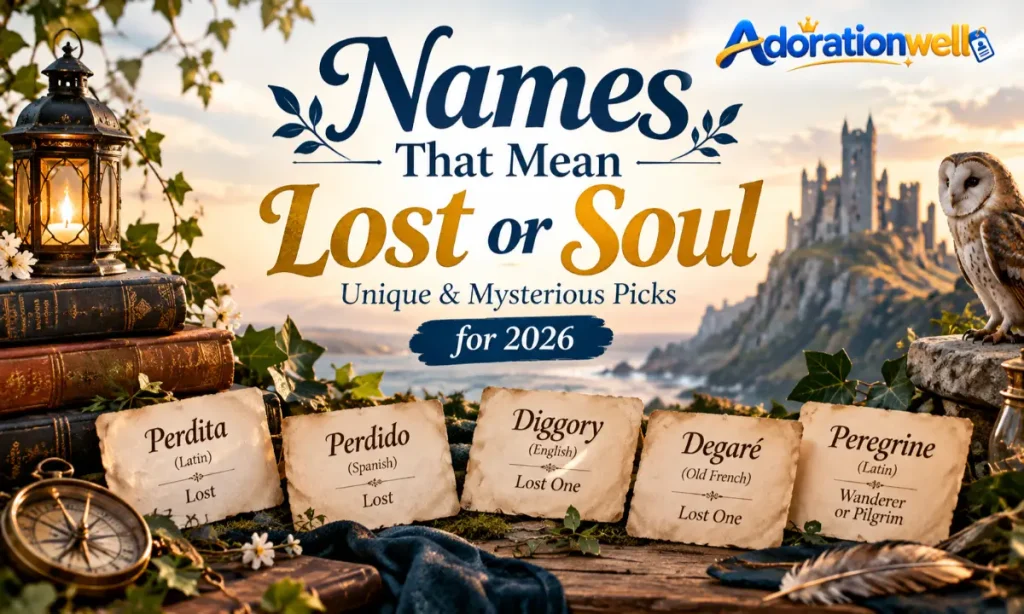
- Perdita (Latin) — Perdita means “lost,” plain and simple. Shakespeare invented it as a given name for the abandoned baby in The Winter’s Tale, and it’s still the clearest answer to “is there a name that means lost?”
- Perdido (Spanish) — This is the Spanish word for “lost,” and the masculine counterpart to Perdita. It’s rarely used as a given name, which makes it striking, though most listeners will hear a word before a name.
- Diggory (English, from Old French) — Diggory likely traces to the medieval French Degaré, “lost one.” It feels like a storybook boy who wandered out of a Gothic novel, and it has a long history in the English West Country.
- Degaré (Old French) — Before Diggory, there was Sir Degaré, a medieval romance about a foundling raised away from his parents. The name is taken to mean “lost one,” and it’s a bold choice for a character.
- Peregrine (Latin) — From peregrinus, “wanderer” or “pilgrim,” the same root that gave English “pilgrim.” It also names the peregrine falcon, a bird that roams across continents.
- Wendel (German) — Wendel means “wanderer” and ties back to the old Germanic Wends. It sounds retro and friendly, which suits a child who wanders without ever being truly lost.
- Dido (Phoenician/Greek) — Some sources link Dido to “wanderer.” Virgil’s queen of Carthage fled her home city of Tyre to found a new one, then died abandoned by Aeneas.
- Randir (Sindarin) — Tolkien’s invented Elvish word for “wanderer, pilgrim,” built from ran (“to stray”) and dîr (“man”). Gandalf’s Elvish title is made from it.
- Rána (Quenya) — Tolkien’s Elvish name for the Moon, usually translated “wayward.” Its root means “to wander,” so the Moon becomes a drifting spirit crossing the night sky.
- Tarka (English, literary) — Henry Williamson’s 1927 novel Tarka the Otter gave us this name, said to mean “wandering as water.” It’s a gentle, unusual pick for a child who flows wherever life goes.
Best pick from these names that mean lost soul: Perdita, for its direct meaning and its Shakespeare backstory.
Names That Mean Lost Boy
Searches for lost boy names usually lead to foundlings and exiles. These legendary boys were abandoned, set adrift or left behind. That makes them natural names that mean lost soul for a son or a hero.
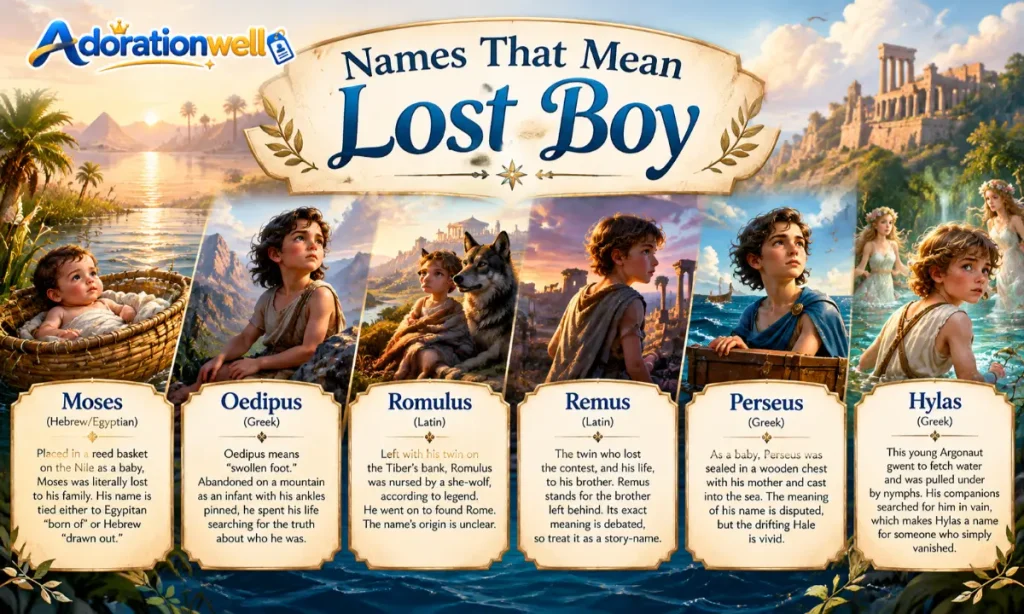
- Moses (Hebrew/Egyptian) — Placed in a reed basket on the Nile as a baby, Moses was literally lost to his family. His name is tied either to Egyptian “born of” or Hebrew “drawn out.”
- Oedipus (Greek) — Oedipus means “swollen foot.” Abandoned on a mountain as an infant with his ankles pinned, he spent his life searching for the truth about who he was.
- Romulus (Latin) — Left with his twin on the Tiber’s bank, Romulus was nursed by a she-wolf, according to legend. He went on to found Rome. The name’s origin is unclear.
- Remus (Latin) — The twin who lost the contest, and his life, to his brother. Remus stands for the brother left behind. Its exact meaning is debated, so treat it as a story-name.
- Perseus (Greek) — As a baby, Perseus was sealed in a wooden chest with his mother and cast into the sea. The meaning of his name is disputed, but the drifting tale is vivid.
- Hylas (Greek) — This young Argonaut went to fetch water and was pulled under by nymphs. His companions searched for him in vain, which makes Hylas a name for someone who simply vanished.
- Ishmael (Hebrew) — Meaning “God hears,” Ishmael was sent into the desert with his mother Hagar. Melville later gave the name to the wandering narrator of Moby-Dick.
- Paris (Greek) — Left on Mount Ida as an infant because of a bad omen, Paris was raised among shepherds. The name’s origin is uncertain, but his lost childhood shaped a war.
- Cyrus (Persian) — Herodotus tells of Cyrus the Great being ordered killed as a baby and secretly raised by a herdsman. The name may relate to “sun,” though scholars aren’t sure.
- Tristan (Celtic) — Probably from the Pictish Drustan, later bent toward French triste, “sorrowful.” Tristan was an orphan raised far from home, and his love story ends in tragedy.
Best pick from these names that mean lost soul: Moses, for the most famous lost-child story in the world.
Read More: 60+ Badass Boy Names With Meanings: Strong, Bold & Powerful Picks
Names Meaning Lost Child
Lost child names often come from fairy tales and stories of foundlings. In these names that mean lost soul, the loss is early, and the return is uncertain.
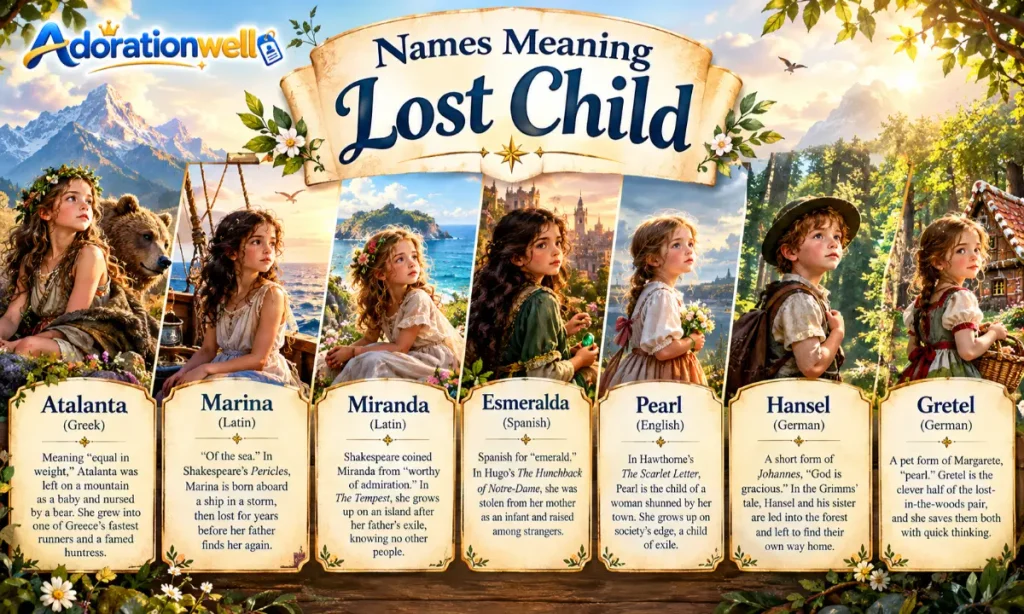
- Atalanta (Greek) — Meaning “equal in weight,” Atalanta was left on a mountain as a baby and nursed by a bear. She grew into one of Greece’s fastest runners and a famed huntress.
- Marina (Latin) — “Of the sea.” In Shakespeare’s Pericles, Marina is born aboard a ship in a storm, then lost for years before her father finds her again.
- Miranda (Latin) — Shakespeare coined Miranda from “worthy of admiration.” In The Tempest, she grows up on an island after her father’s exile, knowing no other people.
- Esmeralda (Spanish) — Spanish for “emerald.” In Hugo’s The Hunchback of Notre-Dame, she was stolen from her mother as an infant and raised among strangers.
- Pearl (English) — In Hawthorne’s The Scarlet Letter, Pearl is the child of a woman shunned by her town. She grows up on society’s edge, a child of exile.
- Hansel (German) — A short form of Johannes, “God is gracious.” In the Grimms’ tale, Hansel and his sister are led into the forest and left to find their own way home.
- Gretel (German) — A pet form of Margarete, “pearl.” Gretel is the clever half of the lost-in-the-woods pair, and she saves them both with quick thinking.
- Oliver (Latin) — Usually linked to the olive tree. Dickens’ Oliver Twist is the classic orphan, a boy without family who drifts through the city’s harshest corners.
Best pick from these names that mean lost soul: Marina, for its lovely sound and a story with a happy return.
Boy Names That Mean Soul
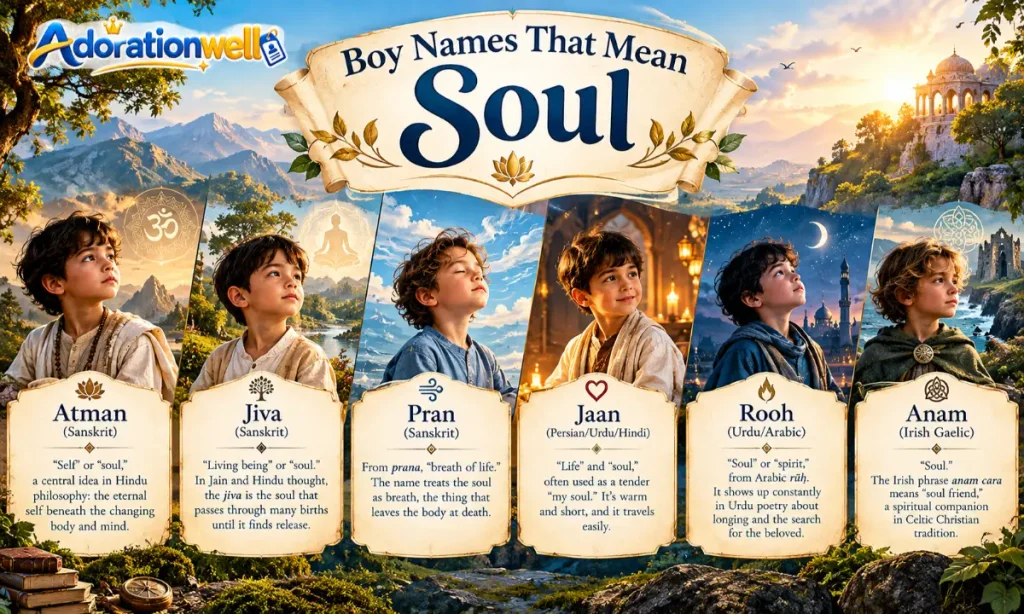
These soul words come from many traditions. Some are rare as given names, so they work best for parents who want a quiet, spiritual meaning. They’re direct examples of names that mean lost soul’s opposite, the soul itself, and they fit when you want depth without darkness.
- Atman (Sanskrit) — “Self” or “soul,” a central idea in Hindu philosophy: the eternal self beneath the changing body and mind.
- Jiva (Sanskrit) — “Living being” or “soul.” In Jain and Hindu thought, the jiva is the soul that passes through many births until it finds release.
- Pran (Sanskrit) — From prana, “breath of life.” The name treats the soul as breath, the thing that leaves the body at death.
- Jaan (Persian/Urdu/Hindi) — “Life” and “soul,” often used as a tender “my soul.” It’s warm and short, and it travels easily.
- Rooh (Urdu/Arabic) — “Soul” or “spirit,” from Arabic rūḥ. It shows up constantly in Urdu poetry about longing and the search for the beloved.
- Anam (Irish Gaelic) — “Soul.” The Irish phrase anam cara means “soul friend,” a spiritual companion in Celtic Christian tradition.
- Tama (Japanese) — Written 魂 it means “soul,” and written 玉 it means “jewel.” Both readings suit a precious inner spirit.
- Shen (Chinese) — 神 means “spirit” or “god,” and the sound also appears in other meanings. In Chinese thought, shen is the vital spirit of a person.
- Pneuma (Greek) — “Breath” or “spirit.” It’s the Greek New Testament’s word for spirit, and the root of the English word “pneumatic.”
- Animus (Latin) — “Soul, mind, courage.” Carl Jung used it for the inner masculine side of a person, so it carries psychological depth.
- Ruach (Hebrew) — “Wind, breath, spirit.” In Genesis, it’s the ruach that moves over the waters before creation begins.
- Nefesh (Hebrew) — “Soul” or “living being.” In biblical Hebrew, it’s the life-force in every creature.
- Ruhi (Arabic) — “My spirit” or “spiritual.” It works for any gender and sounds light and modern.
- Hun (Chinese) — 魂 is the “soul” in Chinese thought, the spirit part that may linger after death. It’s the closest match to a wandering ghost.
- Ka (Egyptian) — The ka was a person’s vital essence in ancient Egypt, a spiritual double that needed offerings after death. It’s a one-syllable name with deep history.
Best pick from these names that mean lost soul: Anam, for its warmth and a clear, friendly pronunciation (AH-num).
Unique Soul Names for Girl
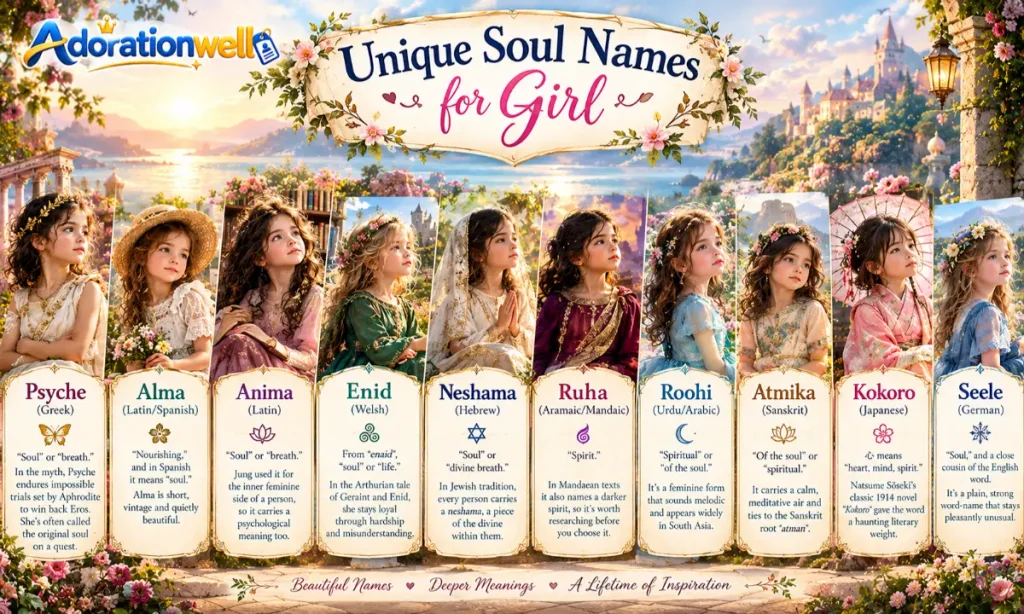
Here are girl names that carry “soul” or “spirit” in their roots. Some are classics, and some are rare. Together, these names that mean lost soul’s gentler cousins give you elegant choices.
- Psyche (Greek) — “Soul” or “breath.” In the myth, Psyche endures impossible trials set by Aphrodite to win back Eros. She’s often called the original soul on a quest.
- Alma (Latin/Spanish) — Latin for “nourishing,” and in Spanish it means “soul.” Alma is short, vintage and quietly beautiful.
- Anima (Latin) — “Soul” or “breath.” Jung used it for the inner feminine side of a person, so it carries a psychological meaning too.
- Enid (Welsh) — From enaid, “soul” or “life.” In the Arthurian tale of Geraint and Enid, she stays loyal through hardship and misunderstanding.
- Neshama (Hebrew) — “Soul” or “divine breath.” In Jewish tradition, every person carries a neshama, a piece of the divine within them.
- Ruha (Aramaic/Mandaic) — “Spirit.” In Mandaean texts it also names a darker spirit, so it’s worth researching before you choose it.
- Roohi (Urdu/Arabic) — “Spiritual” or “of the soul.” It’s a feminine form that sounds melodic and appears widely in South Asia.
- Atmika (Sanskrit) — “Of the soul” or “spiritual.” It carries a calm, meditative air and ties to the Sanskrit root atman.
- Kokoro (Japanese) — 心 means “heart, mind, spirit.” Natsume Sōseki’s classic 1914 novel Kokoro gave the word a haunting literary weight.
- Seele (German) — “Soul,” and a close cousin of the English word. It’s a plain, strong word-name that stays pleasantly unusual.
- Nafsi (Swahili/Arabic) — “Soul” in Swahili, from Arabic nafs, “self” or “soul.” It’s rare and rhythmic.
- Esprit (French) — “Spirit” or “wit.” Esprit points to the lively side of the soul, not the sorrowful one.
- Sielu (Finnish) — Finnish for “soul.” It’s very rare as a name, which gives it a quiet, northern mystery.
Best pick from these names that mean lost soul: Psyche, since it means “soul” and tells a full story of searching.
Male Names That Mean Lost Soul
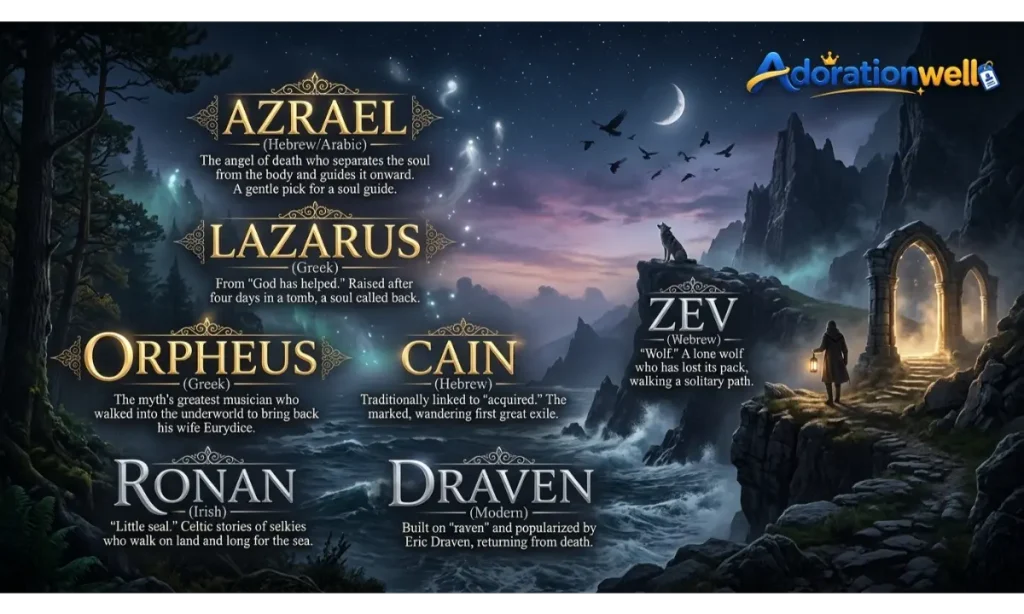
Male names that mean lost soul often lean toward exile, solitude and haunted figures. Wolves, ravens, forests and biblical wanderers appear again and again. The wordplay rarely says “lost” outright, which is why these names that mean lost soul read as elegant, not on-the-nose.
- Azrael (Hebrew/Arabic) — In Jewish and Islamic tradition, Azrael is the angel who separates the soul from the body and guides it onward. It’s a solemn, gentle pick for a soul guide.
- Lazarus (Greek, from Hebrew) — The Greek form of Eleazar, “God has helped.” In the Gospel of John, Jesus raises Lazarus after four days in a tomb, a soul called back.
- Orpheus (Greek) — The myth’s greatest musician walked into the underworld to bring back his wife Eurydice, then lost her by looking back. The name’s own meaning is unclear.
- Cain (Hebrew) — Traditionally linked to “acquired.” After killing his brother Abel, Cain was marked and sent wandering, making him the first great exile in Western story.
- Zev (Hebrew) — Simply “wolf.” A lone wolf has lost its pack, and that picture of solitary roaming makes Zev ideal for a boy who walks his own path.
- Ronan (Irish) — “Little seal.” Seals appear in Celtic stories of selkies, who shed their skins to walk on land and long for the sea. Ronan fits that pull between two worlds.
- Draven (modern coinage) — Built on “raven” and popularized by Eric Draven, the hero of The Crow who returns from death. It reads dark but wearable.
- Kael (Gaelic) — From caol, “slender.” It’s a short, sleek name that feels like someone passing through quietly, and it pairs well with softer middle names.
- Silas (Latin) — A form of Silvanus, “of the forest.” The biblical Silas traveled with Paul across Asia Minor, so the name carries both wilderness and wandering.
- Theron (Greek) — “Hunter.” A hunter who tracks alone through unfamiliar land is a classic wandering figure. Say it THAIR-on.
- Ezekiel (Hebrew) — “God strengthens.” The prophet received his visions while living among exiles in Babylon, so the name holds displacement and spiritual searching.
- Lucian (Latin) — From lux, “light.” The ancient writer Lucian of Samosata wrote comic dialogues set among the dead, so the name sits in both light and shadow.
- Alaric (Gothic) — “Ruler of all.” The Visigoth king Alaric led a people without a settled homeland and sacked Rome in 410.
- Soren (Danish) — From Latin severus, “stern.” Søren Kierkegaard made it famous through philosophy about anxiety and the search for meaning.
- Dorian (Greek) — “Of the Dorians,” an ancient Greek people. In Oscar Wilde’s novel, Dorian Gray trades his soul for lasting youth, the literary classic of a corrupted soul.
- Corvin (Latin) — From corvus, “raven.” Ravens carry omens in many cultures, and Corvin suits a thoughtful, brooding boy.
- Riven (English) — “Torn apart.” A riven soul is a split one. Riven sounds modern and spare, with an echo of “river.”
Best pick from these names that mean lost soul: Azrael, for its meaning as a guide of souls.
Boy Names That Mean Lost Soul
Here’s a second round of boy names that mean lost soul. These lean on saints, heroes and literary wanderers. Each one comes with a story you can tell, which gives your pick real depth. Treat these names that mean lost soul as a toolkit for fiction or fatherhood.
- Malachi (Hebrew) — “My messenger.” It’s the name of the last of the minor prophets in many Bibles, and it suits a soul carrying a message across a long road.
- Emrys (Welsh) — The Welsh form of Ambrosius. In Welsh legend, Merlin is called Myrddin Emrys, a solitary seer who retreats to the forest.
- Alastor (Greek) — “Avenger,” also the name for a vengeful spirit. Shelley’s poem Alastor, or the Spirit of Solitude follows a poet who wanders in search of an ideal.
- Ambrose (Greek) — “Immortal.” Saint Ambrose served as bishop of Milan, and the name hints at a soul that outlasts the body.
- Caspian (English) — From the Caspian Sea. C. S. Lewis used it for an exiled prince in Narnia who must reclaim his lost kingdom.
- Osric (Old English) — “Divine ruler.” In Hamlet, Osric is a minor courtier who appears in a doomed court, a small figure caught in a larger tragedy.
- Odran (Irish) — Linked to a word for “pale” or “sallow.” According to legend, Saint Odran volunteered to be buried alive at Iona to consecrate the ground.
- Corentin (Breton) — A Breton saint who lived as a hermit and, as the story goes, was fed by one miraculous fish a day. He’s a patron of quiet solitude.
- Barrow (English) — A burial mound, from Old English beorg. Barrows are Bronze Age graves, so the name reads as forgotten places and the dead who rest there.
- Fenwick (Old English) — “Fen farm,” a dwelling by the marsh. Marshes are where will-o’-the-wisps drift, so Fenwick feels like a lonely light over wet ground.
- Dante (Italian) — Short for Durante, “enduring.” Dante Alighieri opens the Divine Comedy lost in a dark wood, then walks through hell to find his way out.
- Aeneas (Greek) — Meaning uncertain. The Trojan survivor fled his burning city and wandered the Mediterranean for years to found a new home.
- Odysseus (Greek) — Often linked to “trouble” or “anger.” Odysseus spent ten years wandering after the Trojan War, the great model of the long way home.
- Jude (Hebrew) — From Judah, “praised.” Saint Jude is the patron of lost causes, so the name suits anyone who loves hopeless underdogs.
- Jonah (Hebrew) — “Dove.” The prophet fled his mission, was swallowed by a great fish and returned to land changed.
- Ichabod (Hebrew) — “The glory has departed.” Washington Irving’s schoolmaster Ichabod Crane vanishes after meeting the Headless Horseman in The Legend of Sleepy Hollow.
- Leander (Greek) — “Lion man.” Leander swam the Hellespont each night to see his love Hero, and drowned one stormy night.
- Rurik (Old Norse) — “Famous ruler.” The semi-legendary Rurik led his people into Slavic lands and founded a dynasty far from his birthplace.
Best pick from these names that mean lost soul: Dante, for a real hero’s lost-in-the-woods story.
Girl Names That Mean Lost Soul
Girl names that mean lost soul tend to feel ethereal. They draw on moons, seas, goddesses and tragic heroines. If you like a name with moonlight in it, these names that mean lost soul will likely appeal. Each one links to a real myth or place.
- Selene (Greek) — “Moon.” The goddess Selene drives the lunar chariot across the night sky and falls for the sleeping shepherd Endymion, a love that never wakes.
- Mara (Hebrew) — “Bitter.” In the Book of Ruth, Naomi asks to be called Mara after losing her husband and sons, a name taken in grief.
- Isolde (Celtic/Germanic) — Origin uncertain. The Arthurian princess Isolde loves Tristan in a doomed romance that crosses oceans and ends in death.
- Althea (Greek) — “Healer.” In myth, Althaea holds the burning log tied to her son’s life, a mother caught in an unbearable choice.
- Thalassa (Greek) — “Sea.” Xenophon’s soldiers cried “Thalassa!” when they finally saw the sea after a long retreat through hostile land.
- Nerissa (Greek) — From the Nereids, sea nymphs. Shakespeare gave it to Portia’s lady-in-waiting in The Merchant of Venice.
- Calista (Greek) — “Most beautiful.” The nymph Callisto was turned into a bear in myth, then placed among the stars as a constellation.
- Nyx (Greek) — The goddess of night, so powerful that Zeus feared her, according to the Iliad. Nyx is the quintessential dark-aesthetic name.
- Vespera (Latin) — “Evening.” It evokes the hour when the first star appears and daylight fades, a threshold between day and night.
- Drusilla (Latin) — A diminutive of Drusus. Julia Drusilla, sister of Caligula, died young in 38 AD, and he had her declared a goddess.
- Rhiannon (Welsh) — “Great queen.” In the Mabinogion, Rhiannon is falsely accused of killing her baby and forced to carry visitors on her back as penance.
- Elara (Greek) — In myth, Elara was a lover of Zeus, hidden underground to keep her from Hera. Jupiter’s moon Elara carries her name.
- Astraea (Greek) — “Star maiden.” The goddess of justice left earth as humanity declined and rose to the sky as the constellation Virgo.
- Melaina (Greek) — “Dark” or “black.” Melaina was an epithet for Demeter in her grief when she searched for her lost daughter.
- Morrigan (Irish) — “Phantom queen” or “great queen.” The Celtic war goddess appears as a crow before battles, foretelling death.
- Lilith (Hebrew) — In Jewish folklore, Lilith is Adam’s first wife, who left Eden. The name may also echo Mesopotamian lilitu spirits.
- Ondine (French) — A water spirit from folklore who gains a soul by marrying a mortal, and dies if he’s unfaithful. Few myths tie water, love and soul so tightly.
- Seren (Welsh) — “Star.” It’s a bright, guiding name, perfect for a child meant to light the way for lost travelers.
- Vanora (Scots) — A Scots form of Guinevere, the Arthurian queen. It carries her story of divided love and loss.
- Eira (Welsh) — “Snow.” Snow muffles sound and covers paths, so Eira evokes a landscape where travelers can easily lose their way.
Best pick from these names that mean lost soul: Selene, for its simplicity and moon-soaked mystery.
Names That Mean Lost Girl
These names tie to girls who were abandoned, banished, or left to find their own path. They’re names that mean lost soul with a personal heartbreak, and each one comes with a story. Use them for characters or children when you want that tender, haunted note.
- Ariadne (Greek) — “Most holy.” Ariadne helped Theseus escape the labyrinth, then was left behind on the island of Naxos while he sailed away.
- Briseis (Greek) — In the Iliad, Briseis is a captive passed between men like a prize, her fate decided by others.
- Dolores (Spanish) — “Sorrows.” It comes from Our Lady of Sorrows, and nicknames like Lola give it a lighter feel.
- Alice (Germanic) — “Noble.” Lewis Carroll’s Alice tumbles into a world where nothing follows the rules, which makes her the best-known literary girl lost in wonder.
- Evangeline (Greek) — “Good news.” In Longfellow’s poem, Evangeline searches across North America for the lover she was separated from, never giving up.
- Lorelei (German) — The Lorelei is a Rhine cliff, and legend says a siren there lured sailors to their deaths. Heine’s 1824 poem made the story famous.
- Noa (Hebrew) — “Movement.” It’s a short, airy name that suits a soul always on the move.
- Thana (Greek) — Rare, and echoing Thanatos, Greek for “death.” It’s best for a character whose story is steeped in mortality.
- Senara (Cornish) — Saint Senara of Zennor was, in legend, set adrift in a barrel by her father after a false accusation and washed up in Ireland.
- Zora (Slavic) — “Dawn.” It’s the light that follows a long, lost night, a hopeful name with a shadow behind it.
- Celestine (Latin) — “Heavenly.” It suits a soul that looks beyond the earthly, with a soft, old-fashioned sparkle.
- Ravenna (Italian) — An Italian city of glittering mosaics. Dante died in exile in Ravenna, so the name echoes a soul far from home.
- Zephyrine (French/Greek) — “West wind.” The wind never settles in one place, so Zephyrine is a poetic name for a drifting spirit.
Best pick from these names that mean lost soul: Senara, for a rare name with a vivid story.
Unisex Names That Mean Lost Soul
Unisex names that mean lost soul usually draw on nature, weather and abstract ideas, not on gendered myths. They’re popular for babies and for fantasy or gaming characters where flexibility matters. Short and strong, these names that mean lost soul work on nearly anyone.
- Wren (English) — A tiny, brown songbird. Despite its size, the wren sings loudly, so the name suggests quiet strength.
- Ash (English) — From the ash tree and also the remains of a fire. Ash is what’s left after loss, which gives it a bittersweet edge.
- Sage (Latin) — From sapere, “to be wise.” It’s wisdom found through wandering and a soft herb used in cleansing rituals.
- Rowan (Irish) — The rowan tree, believed in folklore to ward off wandering spirits and witches. It’s a protective, grounded choice.
- Onyx (Greek) — From onyx, “claw” or “fingernail,” a banded dark stone. It hints at hidden depths.
- Shiloh (Hebrew) — A biblical town where the tabernacle stood. It’s tied to rest and peace, the place a wandering soul might finally settle.
- Zephyr (Greek) — The west wind, light and ever-moving. It’s gentle yet restless, and always on the way somewhere else.
- Indigo (Greek) — From indikon, “from India,” a deep blue dye. The color of twilight suits a brooding, thoughtful child.
- Ren (Japanese) — Written 蓮 it means “lotus,” which rises from muddy water. Written with other kanji it can mean “love.”
- Echo (Greek) — The nymph Echo was cursed to repeat only others’ last words, then faded until only her voice remained.
- Wraith (Scottish) — A ghostly apparition, probably Scottish in origin though its roots are uncertain. It’s literal, spooky and best for characters.
- Kit (English) — A short form of Christopher or Katherine. It’s quick and nimble, like a small wanderer slipping through tight places.
- Skye (Scottish) — The Isle of Skye, a misty Scottish island of dramatic cliffs. It suggests wide-open, boundless space.
- Raven (English) — The bird of omens and prophecy in countless cultures. Raven is one of the most direct dark-aesthetic names.
- Phoenix (Greek) — The mythic bird that burns and rises from its own ashes. It’s a lost soul reborn.
- Wisp (English) — A small, flickering light or thread of smoke. A will-o’-the-wisp is a ghost light that leads travelers astray.
- Storm (English) — A turbulent weather name for an unsettled soul. It’s bold, dramatic and often used in fantasy.
- River (English) — Always moving toward the sea. River is soft, flowing and increasingly popular for babies of any gender.
- Ariel (Hebrew) — “Lion of God.” In The Tempest, Ariel is an airy spirit bound to serve Prospero, longing for freedom.
- Haze (English) — A blur that obscures what lies ahead. It evokes that foggy feeling of being unsure of the way.
- North (English) — The fixed point for those who wander. A soul that has lost its way looks north to find direction again.
- Wilder (English) — Meaning “more untamed.” It’s a modern name for a child who roams where they like.
- Ember (English) — A glowing coal that remains after a fire dies down. It’s the spark of life that survives loss.
- Sable (English) — From the dark fur of the sable animal, and the heraldic word for black. It’s somber and quietly elegant.
- Winter (English) — The season of stillness and dormancy, when the world seems to pause. It’s the cold, quiet side of the soul.
Best pick from these names that mean lost soul: Rowan, for a name rooted in folklore about wandering spirits.
Names Meaning Lost or Forgotten
This category skips soul-specific words and goes straight to the state of being lost or forgotten. Some are borrowed from Latin and Greek, which is why a few feel more like concepts than names. They work well as pen names, usernames and fantasy world-building. They’re also fascinating names that mean lost soul at the edges of the theme. These names that mean lost soul sound the most dramatic of all.
- Lethe (Greek) — “Forgetfulness.” Lethe is the river of the underworld, and in some tellings souls drank from it so they’d forget their lives before being reborn.
- Oblivion (Latin) — The state of being forgotten, from oblivisci, “to forget.” It’s more word than name, so it suits characters and band names.
- Obscura (Latin) — From obscurus, “dark” or “hidden.” You may know it from camera obscura, the “dark chamber” that projected images through a tiny hole.
- Erebus (Greek) — “Deep darkness.” Erebus is a primordial god and also the dim region souls pass through on the way to Hades.
- Acheron (Greek) — “River of woe.” In the underworld, this river is one of those the dead must cross, a path with no return.
- Mirage (French) — From Latin mirari, “to look at.” A mirage is the illusion that draws lost travelers across a desert toward water that isn’t there.
- Labyrinth (Greek) — Daedalus built the labyrinth to trap the Minotaur on Crete. It’s the ultimate metaphor for being lost, a maze with one way out.
- Requiem (Latin) — “Rest.” It’s the first word of the Mass for the dead, so the name carries a hush of mourning.
- Elegy (Greek) — From elegos, a lament sung for the dead. It’s a poem of loss, and a gentle name for a melancholy child.
- Relic (Latin) — From reliquiae, “remains.” A relic is something left behind and half-remembered, like a ghost of an older age.
- Nomad (Greek) — From nomas, “roaming in search of pasture.” It names those who have no fixed home and follow the seasons.
- Exile (Latin) — From exilium, “banishment.” It’s a stark one-word name for a character cut off from the place that made them.
Best pick from these names that mean lost soul: Lethe, a real mythic river with a one-word, easy-to-use sound.
Names That Mean Forgotten
Forgotten names are rare, so these are especially distinctive. Each one adds depth to a collection of names that mean lost soul. These quiet picks of names that mean lost soul work best for stories about memory and silence.
- Lesmona (Greek) — Often given as “she who is forgotten,” though its history is scarce. It’s very rare, which gives a character an air of being half-lost to time.
- Olvido (Spanish) — Spanish for “forgetting” or “oblivion.” It’s a real, if uncommon, name in Spain, so it’s both authentic and haunting.
- Nemo (Latin) — “No one.” Captain Nemo in Jules Verne’s novels hides his past and his name, an exile from the world who becomes nobody on purpose.
- Tacita (Latin) — “Silent.” The Romans honored Dea Tacita, the silent goddess, in rites for the dead, tying her to those no longer remembered.
- Ignotus (Latin) — “Unknown.” Ancient Romans raised altars “to the unknown god,” so the name echoes the mystery of what can’t be named.
Best pick from these names that mean lost soul: Nemo, for its simplicity and its tie to a famous exile.
Names That Mean Lost but Found
Not every lost soul stays lost. These names point toward rescue, return and renewal, and they add hope to the theme. They’re the happy endings of names that mean lost soul, and a good choice if you want shadow without despair. Many of these names that mean lost soul came from stories where someone finds the way back.
- Aletheia (Greek) — “Truth,” literally “un-forgetting,” from a- (not) and lethe (forgetting). It’s the opposite of Lethe, a truth recovered from oblivion.
- Anastasia (Greek) — “Resurrection.” It’s a classic for a girl whose story is about rising again after loss.
- Renata (Latin) — “Reborn.” Renata is elegant and international, and it works in many languages.
- Eureka (Greek) — “I have found it.” Archimedes supposedly shouted it in the bath after solving a puzzle, so it’s the name of a discovery.
- Haven (English) — A safe harbor. It’s the shelter a lost soul seeks, and it’s gentle, modern and easy to say.
- Esperanza (Spanish) — “Hope.” The word has long been a favorite for girls, meaning the light that survives even the darkest night.
- Beatrice (Latin) — “She who brings happiness.” In Dante’s Divine Comedy, Beatrice is the guide who finally leads him toward paradise.
- Virgil (Latin) — The Roman poet Virgil guides Dante through hell and purgatory in the Divine Comedy, a steady companion for a lost traveler.
- Raphael (Hebrew) — “God has healed.” The archangel Raphael is a guide and healer, protecting Tobias on his long journey in the Book of Tobit.
- Felix (Latin) — “Lucky” or “happy.” It’s cheerful and old-fashioned, and it signals a soul that’s found its fortune after wandering.
Best pick from these names that mean lost soul: Aletheia, since it literally means recovering what was forgotten.
Mythological and Literary Names for a Lost Soul
Myths and novels give names centuries of built-in story. They hand a child or character instant depth. That’s why so many of the most famous names that mean lost soul come from them. Here, the names that mean lost soul divide into Greek legends and gothic literature.
Greek Myth and the Underworld
Greek myth is full of lost souls, exiles and the dead. These names that mean lost soul come with built-in legends, and they sound dramatic in any language.
- Persephone (Greek) — Abducted by Hades, she spends part of each year in the underworld. Her name’s meaning is uncertain, but her story defines a soul between two worlds.
- Eurydice (Greek) — “Wide justice.” Orpheus’s wife died of a snakebite and was lost to him forever when he glanced back.
- Cassandra (Greek) — Apollo cursed Cassandra so that her true prophecies would never be believed. She’s the soul who sees the truth and cannot be heard.
- Andromeda (Greek) — “Ruler of men.” Chained to a cliff as a sacrifice to a sea monster until Perseus rescued her, she’s a name for the abandoned.
- Medea (Greek) — “Cunning.” This sorceress helped Jason, then was exiled and betrayed, and her story is one of Greece’s darkest.
- Antigone (Greek) — Sophocles’ heroine defies the king to bury her brother and is sealed in a cave as punishment.
- Hecate (Greek) — The goddess of crossroads, ghosts and magic. She holds torches at the places where lost travelers choose a path.
- Charon (Greek) — The ferryman who rows the dead across the river Styx, usually for a coin placed with the body.
- Tantalus (Greek) — Condemned to stand in water he can’t drink and under fruit he can’t reach. His name gave us “tantalize.”
- Sisyphus (Greek) — Doomed to push a boulder uphill forever. Camus later made him a symbol of searching for meaning in a pointless task.
- Niobe (Greek) — After her children were killed, Niobe wept so long she turned to stone. Her name stands for grief that never ends.
- Daphne (Greek) — “Laurel.” Fleeing Apollo, Daphne was turned into a laurel tree, a transformation that saved her but ended her life as she knew it.
- Icarus (Greek) — The boy whose wax wings melted when he flew too near the sun. He’s the fallen soul who reached too high.
Best pick from these names that mean lost soul: Persephone, a name with a story of both loss and return.
Shakespeare and Gothic Literature
Writers like Shakespeare, Poe and the Brontës turned wandering and heartbreak into art. These names that mean lost soul bring that Romantic mood. They’re favorites for fans of the dark academia look, and rich names that mean lost soul for novels.
- Ophelia (Greek) — “Help.” Hamlet’s Ophelia loses her father and her love, goes mad, and drowns, the most famous lost soul in English drama.
- Desdemona (Greek) — Often read as “ill-fated.” Othello’s wife is murdered by the husband she trusted, a tragic heroine who never saw it coming.
- Lenore (English) — Poe’s narrator in “The Raven” mourns the lost Lenore, a name that has meant sorrow and longing ever since.
- Cordelia (Latin/Celtic) — King Lear’s youngest daughter, banished by her father for refusing to flatter him. She returns to save him, then dies.
- Heathcliff (English) — “Heath cliff.” In Wuthering Heights, Heathcliff is a foundling picked up from the streets of Liverpool, a wild soul on the Yorkshire moors.
- Havisham (English) — Dickens’ Miss Havisham is jilted on her wedding day and stops every clock in the house, living in a frozen moment of loss.
- Mariana (Latin) — Tennyson’s poem and Shakespeare’s Measure for Measure both feature Mariana, waiting alone in a moated grange for a man who never comes.
- Carmilla (invented) — Le Fanu’s 1872 novella gave us this name for a vampire who haunts a lonely castle. It predates Dracula by 25 years.
- Elaine (Old French) — Tennyson’s Elaine of Astolat dies of unrequited love and floats down the river to Camelot in a boat.
- Manfred (Germanic) — “Man of peace.” Byron’s Manfred is a tormented hero wandering the Alps, tortured by guilt and unable to find rest.
- Ligeia (Greek) — “Clear-voiced.” It’s the name of one of the sirens, and Poe borrowed it for a story about a dead wife who returns.
- Annabel (Latin) — Poe’s final poem “Annabel Lee” mourns a lost young love by the sea, and it inspired the spelling Annabel.
Best pick from these names that mean lost soul: Ophelia, a fully formed lost-soul heroine.
Folklore, Ghost and Afterlife Names
Around the world, people have named wandering spirits, ghost lights and the places the dead wait. These words make striking names that mean lost soul for fiction, games and creative projects. Some are real terms, not given names, so use them with care. These folk names that mean lost soul are best for characters and worlds.
- Melinoe (Greek) — A minor goddess of ghosts in Orphic hymns. She walks the earth at night followed by restless spirits.
- Hitodama (Japanese) — “Human soul.” It names the floating fireballs seen in Japanese folklore, believed to be souls that have left the body.
- Aleya (Bengali) — A marsh ghost light seen over wetlands in Bengal. Folk belief says it leads travelers off the path.
- El Silbón (Spanish) — A Venezuelan and Colombian legend of a whistling spirit who wanders the plains, said to be a lost soul doing penance.
- Bardo (Tibetan) — “In-between state.” In some Buddhist schools, the bardo is the passage between death and rebirth, a name for the threshold itself.
- Barzakh (Arabic) — In Islamic belief, Barzakh is the barrier between death and the Day of Judgment, where souls wait.
- Asphodel (Greek) — The meadow in the Greek underworld where ordinary souls, neither good nor wicked, are said to linger. It’s also a flower.
- Dybbuk (Hebrew/Yiddish) — In Jewish folklore, a dybbuk is a restless soul that attaches itself to a living person. It’s a dark, haunting term.
- Preta (Sanskrit) — “Hungry ghost” in Buddhist teaching, a spirit tormented by insatiable craving. It’s a powerful symbol of unfulfilled desire.
- Fifollet (Louisiana French) — From feu follet, “mad fire.” In Cajun folklore it’s a ghost light in the swamp that leads people astray.
- Limbo (Latin) — From limbus, “edge.” It’s the place between heaven and hell in medieval thought, where souls wait without punishment or reward.
- Irrlicht (German) — “Wandering light.” It’s the German name for the will-o’-the-wisp, a ghost light that misleads those who follow it.
Best pick from these names that mean lost soul: Hitodama, for a literal “human soul” with a vivid, glowing image.
Names That Mean Lost Soul in Japanese
Japanese offers delicate words for wandering, shadow and spirit. Many of these are real given names, with meanings that shift depending on the kanji used. These Japanese names that mean lost soul work for babies, characters and creative projects. They’re gentle names that mean lost soul in Japanese, so check the kanji before you commit.
- Mayoi (迷い) — “Lost” or “bewildered.” It describes someone who hasn’t found the right path, and it’s soft and lyrical.
- Reiko (霊子) — A common girl’s name, and with the kanji for “spirit” it reads “spirit child.” Many Reikos use other kanji, such as “clear child.”
- Rei (霊) — Depending on the kanji, it means “spirit,” “zero” or “courtesy.” Spelled with “spirit,” it suits a soul between worlds.
- Kage (影) — “Shadow.” In Japanese, it also describes the glow of light, so it holds both darkness and brightness.
- Yami (闇) — “Darkness.” It’s stark, short and popular in fiction for brooding characters.
- Shiori (栞) — “Bookmark.” A bookmark holds your place and guides you back, which makes Shiori a name for finding the way.
- Ronin (浪人) — “Wave person.” A ronin was a samurai without a master, adrift in society, a real historical wanderer.
- Kiri (霧) — “Mist.” It’s the fog that hides paths and softens the world, and it’s easy to pronounce.
- Kasumi (霞) — “Haze” or “mist.” It suggests a blurry, dreamlike veil over the landscape.
- Hotaru (蛍) — “Firefly.” In Japanese tradition, fireflies are tied to the souls of the dead, which makes it a gorgeous choice.
- Yoru (夜) — “Night.” It’s a one-syllable word for the dark, and works for any gender.
Best pick from these names that mean lost soul: Hotaru, for its link between fireflies and souls.
Names That Mean Lost Soul in Different Languages
Translating “lost soul” gives you phrases more than single names in most languages. They’re useful for writers who want an authentic-sounding term for a character, place or concept. These names that mean lost soul in different languages also work as titles, spells or band names. Here are names that mean lost soul across 18 languages.
| Phrase | Language | Meaning and note |
|---|---|---|
| Anima Perdita | Latin | “Lost soul.” The classical phrase, and a natural fit for fantasy lore or a character’s title. |
| Alma Perdida | Spanish/Portuguese | “Lost soul.” Widely used in songs and titles, and easy for most English speakers to read. |
| Âme Perdue | French | “Lost soul.” It has a romantic, theatrical sound, and works well for a gothic character. |
| Verlorene Seele | German | “Lost soul.” The long, rolling German compound feels weighty and fits a dark fantasy setting. |
| Anima Smarrita | Italian | “Lost soul,” with smarrita suggesting “bewildered” or “gone astray,” a softer nuance. |
| Anam Caillte | Irish Gaelic | “Lost soul.” It echoes older Celtic ideas of a soul that wanders after death. |
| Enaid Coll | Welsh | “Lost soul.” Enaid also gave us the name Enid, so this phrase has a musical, ancient ring. |
| Poteryannaya Dusha | Russian | “Lost soul.” Dusha is central to Russian literature, where the soul is a constant theme. |
| Kadonnut Sielu | Finnish | “Lost soul.” Finnish gives it a stark, northern, almost mythic weight. |
| Zagubiona Dusza | Polish | “Lost soul.” Polish folk tales are full of wandering spirits, so it feels at home in dark stories. |
| Verloren Ziel | Dutch | “Lost soul.” It’s plain and direct, and shows how close Dutch is to German here. |
| Kayıp Ruh | Turkish | “Lost spirit.” Ruh comes from Arabic rūḥ, linking it to a wider Islamic-world vocabulary of soul. |
| Fortapt Sjel | Norwegian | “Lost” or “damned soul.” Fortapt leans toward “perished” or “damned,” which gives it a heavier tone. |
| Neshama Ovedet | Hebrew | “Lost soul.” It combines the Hebrew word for soul with a word for “lost” or “perishing.” |
| Yóuhún (游魂) | Mandarin | “Wandering soul.” In Chinese belief, a yóuhún is a spirit without a resting place. |
| Roho Iliyopotea | Swahili | “Lost soul.” The phrase is clear and rhythmic, and makes a vivid title in East African settings. |
| Linh Hồn Lạc Lối | Vietnamese | “Soul that has lost its way.” It describes a soul that can’t find the road. |
| Bhatakti Atma | Hindi | “Wandering soul.” The phrase is common in Hindi stories about restless spirits. |
Best pick from these names that mean lost soul: Yóuhún, since it’s compact and describes a wandering soul exactly.
Unique Names That Mean Lost Soul
Unique names that mean lost soul are the quiet ones, names you won’t hear on every playground. They tend to be literary, old or surprising. If you want something rare, these names that mean lost soul give you real choices. Each of these names that mean lost soul has a clear origin.
- Marlowe (English) — From an Old English phrase for “remnant of a lake.” Christopher Marlowe, the Elizabethan playwright, made it a literary name.
- Ianthe (Greek) — “Violet flower.” Shelley used it for his daughter, and in Ovid’s tale a girl named Ianthe is transformed.
- Wystan (Old English) — “Battle stone.” The poet W. H. Auden carried it, and Saint Wystan was a martyred prince, a quiet, solitary name.
- Lorcan (Irish) — “Little fierce one.” Saint Lorcán Ó Tuathail was an archbishop of Dublin who died in exile in Normandy.
- Thessaly (Greek) — A region of Greece known in ancient times for witches and sorcery. It’s an unusual place-name with a magical edge.
- Eulalia (Greek) — “Well-spoken.” Saint Eulalia was a young martyr, and Poe wrote a poem called “Eulalie” about a joyful marriage.
- Linus (Greek) — In myth, Linus was a musician killed young, and a lament song called the linos honored him. It’s a gentle, mournful root.
- Morwenna (Cornish) — “Maiden.” Saint Morwenna was a Cornish saint, and the name evokes windswept coastal chapels.
- Lysander (Greek) — “Liberator.” In A Midsummer Night’s Dream, Lysander wanders through an enchanted forest and falls under a spell.
- Isidore (Greek) — “Gift of Isis.” Isidore of Seville compiled an enormous medieval encyclopedia, the work of a quiet scholar in a changing world.
- Evander (Greek) — “Good man.” In Roman legend, Evander was an Arcadian exile who settled on the Palatine hill before Rome existed.
Best pick from these names that mean lost soul: Lysander, for a name rooted in forest wandering.
Cool Names That Mean Lost Soul
Cool names that mean lost soul sound sharp and a little dangerous. They come from Norse myth, Tolkien and old words for stone and shadow. These names that mean lost soul suit bold kids, gamers and characters. Pick the one whose sound you like most among these names that mean lost soul.
- Fenrir (Old Norse) — The monstrous wolf of Norse myth, bound by the gods and fated to break free at Ragnarök. It’s a name for something chained and restless.
- Loki (Old Norse) — The trickster god who shifts shapes and is eventually bound in punishment. He’s both ally and outcast among the gods.
- Gangleri (Old Norse) — “Wayweary one.” It’s one of Odin’s many names when he walks the world disguised as a tired traveler.
- Mithrandir (Sindarin) — “Grey Pilgrim.” It’s Gandalf’s Elvish name in Tolkien’s work, built from words for “grey” and “wanderer.”
- Jericho (Hebrew) — An ancient city whose walls famously fell. It’s a name with a sense of ruin and transformation.
- Kieran (Irish) — “Little dark one.” Saint Ciarán of Clonmacnoise founded a monastery in the Irish midlands, so it joins mystery with calm.
- Cairn (Gaelic) — From carn, a stack of stones marking a path or a grave. Cairns guide lost hikers and honor the dead.
- Rook (English) — A crow-like bird that nests in colonies. Rook is also a chess piece, which gives it an edge.
- Thorne (Old English) — “Thorn.” It’s sharp, guarded and solitary, and suits a wary character with a past.
- Nox (Latin) — “Night.” The Roman goddess Nox was the personification of night, one of the oldest deities in the story of creation.
- Umbra (Latin) — “Shadow.” In astronomy, the umbra is the darkest part of a shadow, so the name is both scientific and spooky.
Best pick from these names that mean lost soul: Gangleri, a real name tied to a wandering god.
Cute Names That Mean Lost Soul
Cute names that mean lost soul wrap sadness in softness. They’re floral, bird-like and light, with a hidden shadow underneath. For a gentle child, these names that mean lost soul offer a sweeter route. These sweet names that mean lost soul pair well with simple middle names.
- Willow (English) — The weeping willow droops over water and has long stood for mourning. Willow is soft, flexible and tender.
- Marigold (English) — In Mexico’s Día de los Muertos, marigolds light the path that guides the dead home. It’s a sunny name with a deep tradition.
- Luna (Latin) — “Moon.” It’s gentle, glowing and widely loved, with ties to night-wandering and dreams.
- Lark (English) — A songbird that sings as it rises into the morning sky. It’s cheerful, with a free-roaming spirit.
- Piper (English) — A pipe player. In the legend of the Pied Piper of Hamelin, the piper leads the town’s children away, never to return.
- Briar (English) — A thorny bramble. Briar Rose is another name for Sleeping Beauty, lost in a hundred-year sleep behind a hedge of thorns.
- Poppy (English) — The red poppy is a symbol of remembrance for soldiers who died in war. It’s bright and tender, with solemn meaning.
- Dove (English) — A symbol of peace and the returning spirit. In the story of Noah, a dove brings back an olive branch to show land is near.
- Lyra (Greek) — “Lyre.” The constellation Lyra honors the instrument of Orpheus, who played so beautifully that he charmed the dead.
- Ivy (English) — An evergreen that climbs over ruins and graves. Ivy clings and endures, an image of a soul that won’t let go.
- Pip (English) — A short form of Philip. Dickens’ Pip is an orphan who grows up searching for who he is and where he belongs.
- Hollis (English) — “Holly trees.” Holly stays green all winter and was believed to protect against dark spirits.
Best pick from these names that mean lost soul: Marigold, for a bright name that guides spirits home.
Modern & Trendy Names That Mean Lost Soul
Modern names that mean lost soul feel current. They’re short, stylish and often borrowed from words, nature or old myths. These names that mean lost soul are rising in popularity and fit contemporary families and characters. Each of these names that mean lost soul still has a real backstory.
- Atlas (Greek) — The Titan condemned to hold up the sky forever. Atlas is bold and strong, with a quiet burden underneath.
- Rumi (Persian) — The 13th-century poet and mystic Rumi wrote about the soul’s longing for its source. It’s lyrical and very current.
- Maverick (English) — An unbranded calf that wanders from the herd. It’s a modern word for someone who follows no group.
- Rune (Norse) — “Secret” or “mystery.” Runes were symbols used for writing and magic, so the name suggests hidden knowledge.
- Saoirse (Irish) — “Freedom.” Pronounced SEER-sha or SUR-sha, it suggests a soul that has slipped its chains.
- Journey (English) — A virtue-style name that celebrates the road itself. It’s direct and cheerful about being on the way.
- Wander (English) — A word name rising in use, simply meaning to roam without a destination. It’s open and unpretentious.
- Lux (Latin) — “Light.” For a soul in the dark, lux is the thing it seeks, and it’s short and trendy.
- Rue (English) — “Regret” or “sorrow,” and also a bitter herb. Rue is a one-syllable name with a quiet ache.
- Eden (Hebrew) — “Delight.” It’s the garden humanity lost, so it carries the idea of paradise left behind.
- Sailor (English) — Someone who travels by water. It’s currently a fashionable name for a child of the open sea and open road.
Best pick from these names that mean lost soul: Rumi, for a modern, melodic name with spiritual depth.
Fantasy Names That Mean Lost Soul
Fantasy names thrive on invention. These are original coinages, so none has an ancient “lost soul” meaning. Instead, each is built from real word roots, so you can see exactly what it suggests. They’re ideal for novels, tabletop games and worldbuilding. Here are names that mean lost soul made from Latin, Greek and Old English. These invented names that mean lost soul come with their building blocks explained.
- Veyra — English “veil” plus the soft ending -a. It suggests something hidden behind a thin curtain.
- Duskara — “Dusk” plus -ara. It sounds like a twilight realm where the day ends and spirits stir.
- Noxelle — Latin nox, “night,” plus the French -elle. It reads as a feminine, elegant “child of night.”
- Aethrael — Greek aithēr, “upper air,” plus the angelic ending -ael. It hints at a spirit adrift in the heavens.
- Wyndrel — “Wind” plus -rel. It’s a name for a drifting soul that goes wherever the breeze takes it.
- Lethane — Built from Lethe, the river of forgetting, plus -ane. It suggests a soul that has drunk from the river.
- Umbrael — Latin umbra, “shadow,” plus -ael. Think of an angel of shadows.
- Cindrel — “Cinder” plus -el. It suggests the last glow of something burned away.
- Ashael — “Ash” plus -ael. It reads like a spirit made of what’s left after a fire.
- Mistwyn — “Mist” plus Old English wyn, “joy.” A joyful soul wrapped in fog, a gentle contradiction.
- Sorwyn — “Sorrow” plus wyn. It’s an ironic mix of grief and joy, as if the two share one name.
- Thornael — “Thorn” plus -ael. It suggests a guarded, prickly spirit with a gentle heart.
- Mournelle — “Mourn” plus -elle. It’s a soft, feminine name for someone steeped in quiet grief.
- Vagrael — Latin vagari, “to wander,” plus -ael. It’s a literal “wandering spirit” with an angelic ring.
- Solivar — From Latin solus (“alone”) and vagus (“wandering”), echoing the rare word solivagant, “one who wanders alone.”
- Noctavian — Latin noctis, “of the night,” plus -ian. It sounds like a nocturnal knight or priest.
- Perdelia — Latin perdere, “to lose,” plus -elia. It’s the closest invented cousin to Perdita.
- Animael — Latin anima, “soul,” plus -ael. It reads as “angel of the soul,” and it’s elegant and clear.
- Errantis — From Latin errare, “to wander” or “stray,” with a noble-sounding ending. It suggests a knight-errant.
Best pick from these names that mean lost soul: Animael, for its clear meaning and graceful sound.
Last Names That Mean Lost Soul
Surnames carry the theme differently. They lean on English landscape words like moor, hollow and wood, and on heraldic images. They feel grounded and less fantastical. These last names that mean lost soul work for characters, pen names and band names. Here are names that mean lost soul in surname form, each with a real origin.
- Blackwood (English) — A dark, dense forest. It’s a classic gothic surname, popular in fiction.
- Graves (English) — A surname from the Old English for a grove or thicket, but its sound ties it directly to burial and mourning.
- Ravenscroft (English) — “Raven’s enclosure.” It’s a place name that combines the bird of omens with a small farm.
- Holloway (English) — From Old English words for a sunken road. It’s a hidden path worn deep into the earth.
- Grimshaw (English) — From Old English grim and sceaga, “grim wood.” It’s a gloomy thicket with a strong, memorable sound.
- Underhill (English) — “Beneath the hill.” It’s an apt name for someone buried or hidden away, and a Tolkien fan’s favorite.
- Thornbury (English) — “Fort by the thorn bushes.” It evokes a guarded, prickly refuge.
- Ashby (Old Norse) — “Ash tree farm.” It’s one of many English place names left by Viking settlers.
- Corbin (French) — From Latin corvus, “raven.” It’s a sleek surname that’s also used as a first name.
- Blackwell (English) — A “dark well” or spring. It suggests hidden water in a shadowed place.
- Hawthorne (English) — From the hawthorn tree. Nathaniel Hawthorne wrote about guilt and secrets in New England, so the name carries moral shadow.
- Poe (English) — From Middle English po, “peacock.” Edgar Allan Poe turned the name into a byword for gothic loss.
- Brontë (Irish/Greek) — Patrick Brontë changed the family spelling, possibly inspired by Greek bronte, “thunder.” His daughters wrote some of literature’s most haunted moors.
- Nightingale (English) — “Night singer.” The bird sings in darkness, and the name fits a soul comforting others in the dark.
- Coldwell (English) — “Cold spring.” It’s a chilly, still place name with a hint of winter.
- Lockwood (English) — “Enclosed wood.” Lockwood is the outsider narrator of Wuthering Heights, stumbling into a haunted house.
- Wynter (English) — A variant of Winter. The unusual spelling adds a touch of antique, storybook mystery.
Best pick from these names that mean lost soul: Blackwood, for a timeless gothic surname.
How We Create Lost Soul Names (Step-by-Step)
Not every name on a list will suit your project. If you’d like to build your own names that mean lost soul, here’s the process we use. It works for both babies and characters, and it keeps the meaning honest.
- Research meanings. Look for words meaning lost, wandering, shadow, soul or exile in several languages. Good names that mean lost soul start with real roots.
- Check languages. Latin, Greek, Hebrew, Norse, Gaelic, French and Japanese give you plenty of material.
- Combine sounds. Blend a root with a soft ending. For example, Latin umbra plus -ael becomes Umbrael.
- Test the symbolism. Make sure the finished name still points to wandering, mystery or the ethereal.
- Test the pronunciation. Say it aloud. A name that looks hauntingly lovely on the page can feel clunky in conversation.
- Add style. Endings like -iel, -a, -ra and -lyn give names a fantasy flavor, while Old English -wyn adds a quiet music.
Following these steps gives you names that mean lost soul with a clear meaning, not just a pretty sound.
Tips for Making Your Lost Soul Name Stand Out
Here’s how to make your pick feel intentional. These tips apply to any of the names that mean lost soul on this list, and they help your choice feel personal.
- Use mystical or shadowed elements such as night, moon, dark or wandering.
- Add endings like -iel, -a, -ra or -lyn for fantasy flair.
- Keep it pronounceable yet haunting, so people can say it without hesitation.
- Pair it with a grounded middle name, so the full name balances mystery and warmth.
- Consider cultural, mythological or literary roots for added depth.
- Decide whether you want the meaning to be obvious or discoverable.
The most memorable names that mean lost soul have a story behind them that you can tell in one sentence.
Will the Meaning Age Well? Baby vs. Character Names
For a baby, think about how a meaning feels over a lifetime. A name like Isolde carries its tragic backstory quietly, while a word like “Forsaken” carries it loudly. Names that mean lost soul are best for babies when the sorrow is in the story, not on the surface.
For a character, you can go bolder. Names that mean lost soul work beautifully for fantasy heroes, ghosts and wanderers. A blend of two roots, like Vagrael or Solivar, reads as more intentional than a name pulled straight from a generator. For a child, stick with real names, and save invented names that mean lost soul for fiction.
Frequently Asked Questions
What are the most popular lost soul names?
The most popular names that mean lost soul include Nyx, Azrael, Ophelia, Orpheus and Persephone. They’re popular because each one carries a famous story of wandering, exile or the underworld. Raven and Luna are also common, with a softer feel.
Are there girl names that mean lost soul?
Yes. Girl names that mean lost soul include Selene, Ophelia, Perdita, Isolde and Ondine. Perdita literally means “lost,” and Psyche means “soul,” so they’re the most direct. Others, like Ariadne and Senara, earn the theme through their legends.
Are lost soul names suitable for babies?
Yes, many names that mean lost soul work well for babies, especially ones with gentle meanings, like Selene, Lyra, Marigold or Rowan. Think about how the meaning will feel over time. A name with a quiet backstory ages better than one with a heavy, obvious meaning.
Can lost soul names be unisex?
Absolutely. Unisex names that mean lost soul include Riven, Wren, Ash, Echo, Onyx and Phoenix. They draw on nature and abstract ideas, not gendered myths, which makes them flexible for babies and for fantasy or gaming characters.
Which cultures have lost soul names?
Names that mean lost soul come from Greek, Latin, Hebrew, Norse, Celtic, Japanese, Sanskrit and Arabic traditions, and from English literature. Each culture has its own wandering spirits, ghost lights and afterlife realms, which gave rise to these names.
Can I create a fantasy lost soul name?
Yes. Combine a root word with a soft ending, such as Latin umbra plus -ael to make Umbrael. Names that mean lost soul built this way are best labeled as original coinages. Always explain the roots, so the meaning stays honest and clear.
Conclusion
No common name literally means “lost soul,” but the options are rich. Perdita, Diggory and Psyche come closest, and legends like Orpheus, Persephone, Ophelia and Dante give names that mean lost soul a depth that few other themes can match. From wandering Japanese words to gothic surnames and invented fantasy names, there’s something here for every baby, character or pen name.
The best names that mean lost soul pass one simple test: you can say them aloud and tell their story in a sentence. Which of these names that mean lost soul sounds like yours? Share your favorite in the comments.
[…] Girl Names That Mean Lightning: Rare & Beautiful Picks 300+ Names That Mean Lost Soul: Unique & Mysterious Picks for 2026 110 Badass Princess Names for Baby Girls With Royal British Roots (2026) 80+ Beautiful […]
[…] 160+ Last Names That Mean Light: Inspiring & Unique Ideas for 2026 250+ Girl Names That Mean Survivor: Strong, Brave & Inspiring 274+ Boy Names That Mean Angel: Heavenly & Unique Ideas for 2026 240+ Girl Names That Mean Lightning: Rare & Beautiful Picks 300+ Names That Mean Lost Soul: Unique & Mysterious Picks for 2026 […]