

You’ve probably saved a dozen name ideas in your phone by now. Some sound lovely but feel too trendy. Others feel safe but a little flat. Classic British names sit in a sweet spot because they’re familiar, graceful, and rooted in real history.
This guide shares classic British names meanings for more than 60 names, from royal favorites to Victorian revivals. Each entry gives you the meaning, the origin, and one detail worth remembering. You’ll also find nicknames, a quick-compare table, and tips for pairing a name with your surname.
Quick answer: Classic British names meanings trace back to Old English, Norman French, Latin, Hebrew, and Celtic roots. Classy boy picks include William (“resolute protector”) and George (“farmer”). Elizabeth (“God is my oath”) is a strong contender for the most British girl name.
60+ Classic British First Names and Their Meanings for Timeless Baby Inspiration
Classic British names meanings work like tiny history lessons. A name like Alfred or Eleanor carries a king, a queen, or a poet along with it. Below, the names are grouped by style, so you can jump straight to the mood you like. Treat the list as a shortlist builder for classic British names meanings you can picture on a birth announcement.
What Makes a British Name “Classic”?
A name earns the “classic” label by lasting. It stays in use across generations, appears in literature and history, and never feels tied to one decade. Classic British names meanings often reveal that lasting power, since the oldest ones come from saints, monarchs, and well-loved novels.
“British” also covers more than England. It includes English, Welsh, Scottish, and Irish traditions. Many of the classic British names meanings here arrived with the Normans after 1066, while others are far older. “English names” usually means names from England alone, so this list casts a slightly wider net.
Classic British Boy Names and Their Meanings
Looking for classy British boy names? Classic British names meanings for boys lean on kings, saints, and storybook heroes. Many have friendly short forms, which means a name that sounds formal on paper can feel playful on the playground. Pick a favorite, and the classic British names meanings below will tell you the rest.
Royal and Historic Names
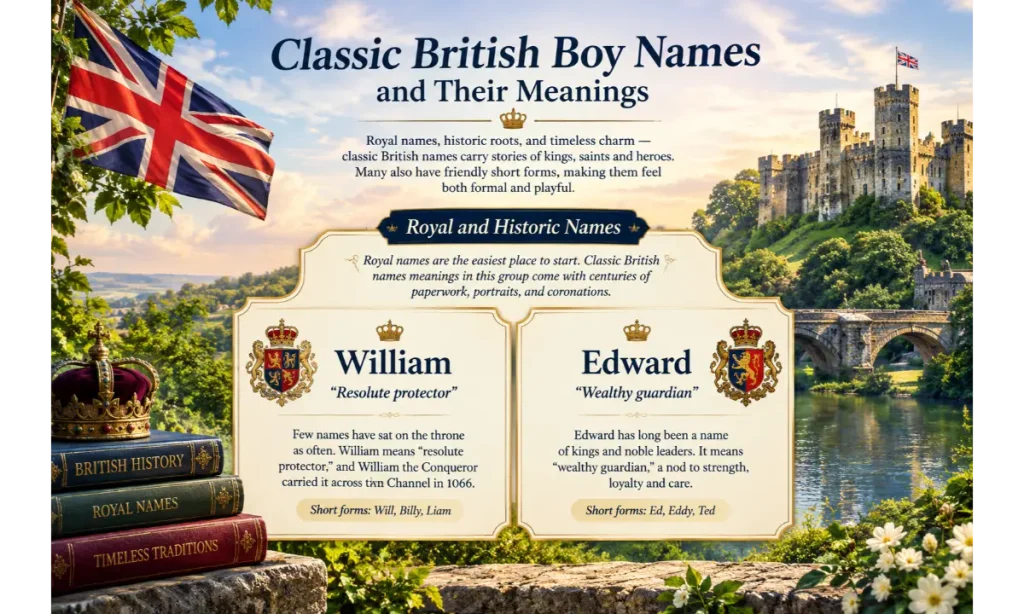
Royal names are the easiest place to start. Classic British names meanings in this group come with centuries of paperwork, portraits, and coronations.
William
Few names have sat on the throne as often. William means “resolute protector,” and William the Conqueror carried it across the Channel in 1066. Today it slides easily between Will, Billy, and Liam.
Edward
The usual reading of Edward is “wealthy guardian.” Eight kings have used it since the Norman Conquest, which gives the name a calm, dependable air. Ed, Eddie, and Ted are all natural nicknames.
Henry
Henry means “home ruler.” Eight English kings wore it, and Shakespeare wrote an entire stage hero around “Prince Hal.” The nickname Harry keeps the name warm, so it works for a toddler and a CEO.
George
George comes from the Greek word for “farmer.” It reached Britain through St. George, the patron saint of England. Six kings named George followed, and Prince George, born in 2013, gave it a fresh spotlight.
Charles
Charles means “free man.” Charles II brought back the monarchy in 1660, and Charles III took the throne in 2022. Writer Charles Dickens adds a literary shine, and Charlie offers a relaxed everyday version.
Old English Heritage Names
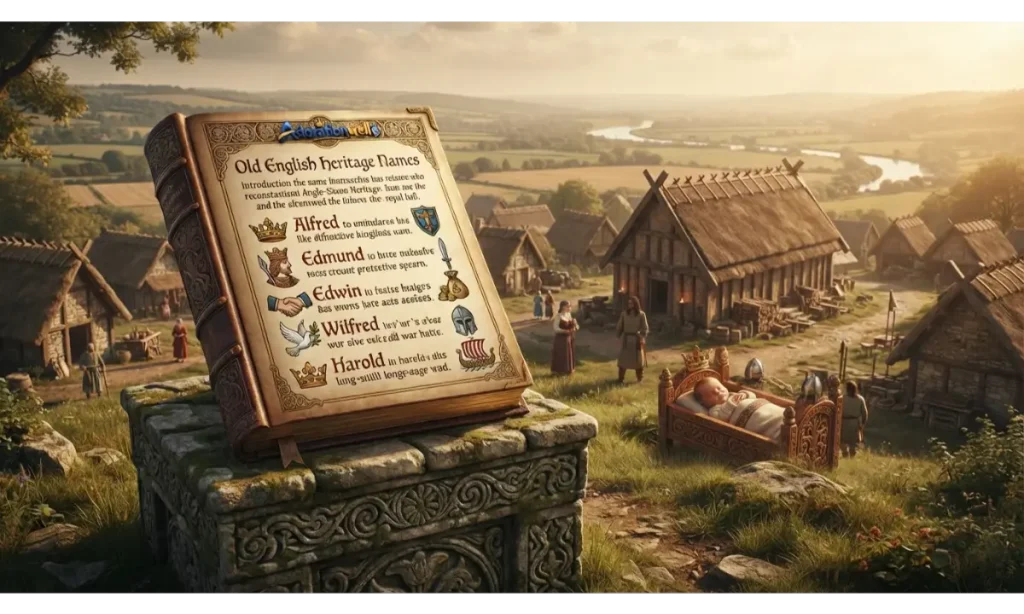
These names go back before the Normans. Classic British names meanings from the Anglo-Saxon era often combine two simple words, such as “rich” and “friend.” Reading these classic British names meanings feels like decoding a tiny poem.
Alfred
Alfred means “elf counsel.” King Alfred the Great defended Wessex against Viking raids in the ninth century and promoted learning across his kingdom. Fred, Freddie, and Alfie all grow naturally from it.
Edmund
Edmund means “prosperous protector.” St. Edmund, the last Anglo-Saxon king of East Anglia, was killed by Danish invaders in the ninth century. His memory kept the name alive in English towns and churches.
Edwin
Edwin translates as “rich friend.” A seventh-century king of Northumbria carried it first. The name sounds soft and slightly old-fashioned, which suits parents who want something familiar but uncommon.
Wilfred
Meaning “desiring peace,” Wilfred honors St. Wilfrid, a seventh-century Northumbrian bishop. It later became linked to the war poet Wilfred Owen. Wilf is a charming short form that sounds fresh today.
Harold
Harold means “army ruler.” Harold Godwinson, the last Anglo-Saxon king of England, fell at the Battle of Hastings in 1066. The name feels sturdy and a little retro, with Harry as a gentle nickname.
Read More: 60+ Badass Boy Names With Meanings: Strong, Bold & Powerful Picks
Gentle Traditional Names
Not every classic has a crown. Classic British names meanings in this group lean toward thoughtful, kind, and bookish. Quiet confidence runs through these classic British names meanings.
Samuel
Samuel is Hebrew for “God has heard.” Diarist Samuel Pepys recorded life in 1660s London, and Samuel Johnson published his famous dictionary in 1755. Sam and Sammy keep it light.
Thomas
Thomas comes from an Aramaic word meaning “twin.” Thomas Becket, the medieval Archbishop of Canterbury, made it well known. Later, Thomas the Tank Engine turned it into a childhood favorite. Tom and Tommy are the usual short forms.
Hugh
Hugh means “mind” or “spirit.” It came to Britain with the Normans, and St. Hugh of Lincoln, a twelfth-century bishop, helped spread it. The name is short and quietly distinguished, with Hughie as a playful extra.
Frederick
Frederick means “peaceful ruler.” The name arrived with the Hanoverian kings, and Frederick, Prince of Wales, was the son of George II. Freddie and Fred give it plenty of everyday charm.
Rupert
Rupert is a form of Robert and means “bright fame.” Prince Rupert of the Rhine commanded Royalist cavalry in the English Civil War. In 1920, Rupert Bear also began his adventures in a British newspaper.
Friendly British Favorites
These are the names you’ll meet at every playgroup. Classic British names meanings here feel warm, short, and easy to call across a park. Even the shortest of these classic British names meanings hides a real story.
Oliver
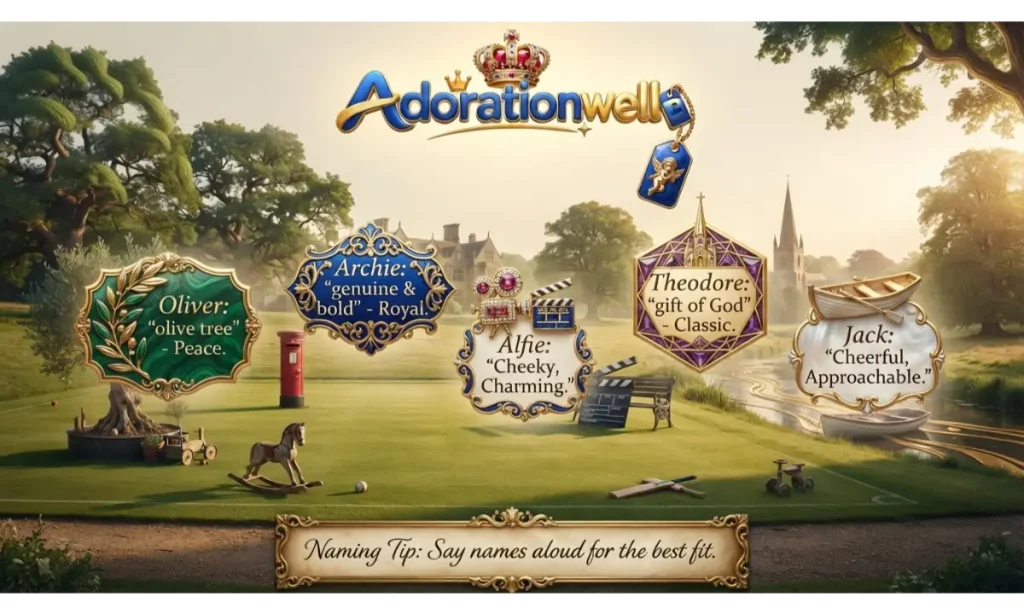
Oliver means “olive tree,” a symbol of peace. It passed from Latin into Old French and then into English. Oliver Cromwell and Dickens’s Oliver Twist made it familiar, and Ollie is the favorite nickname.
Archie
Archie began as a short form of Archibald, which means “genuine” and “bold.” The name has long Scottish ties. Prince Archie, born in 2019, brought it back into the headlines.
Alfie
Alfie started as a pet form of Alfred. A 1966 British film titled Alfie, starring Michael Caine, gave the name a cheeky, charming reputation. It still sounds cheerful and a little mischievous.
Theodore
Theodore is Greek for “gift of God.” Theodore of Tarsus served as Archbishop of Canterbury in the seventh century and helped shape English church life. Theo and Teddy keep the name approachable.
Jack
Jack grew out of Jankin, a medieval pet form of John, which means “God is gracious.” In England and Wales, Jack led the boys’ chart for more than a decade from the mid-1990s. It remains a cheerful classic.
Naming tip: When you compare classic British names meanings for boys, say each name aloud with your surname. A strong first syllable often pairs best with a softer surname, and the reverse is also true.
Classic British Girl Names and Their Meanings
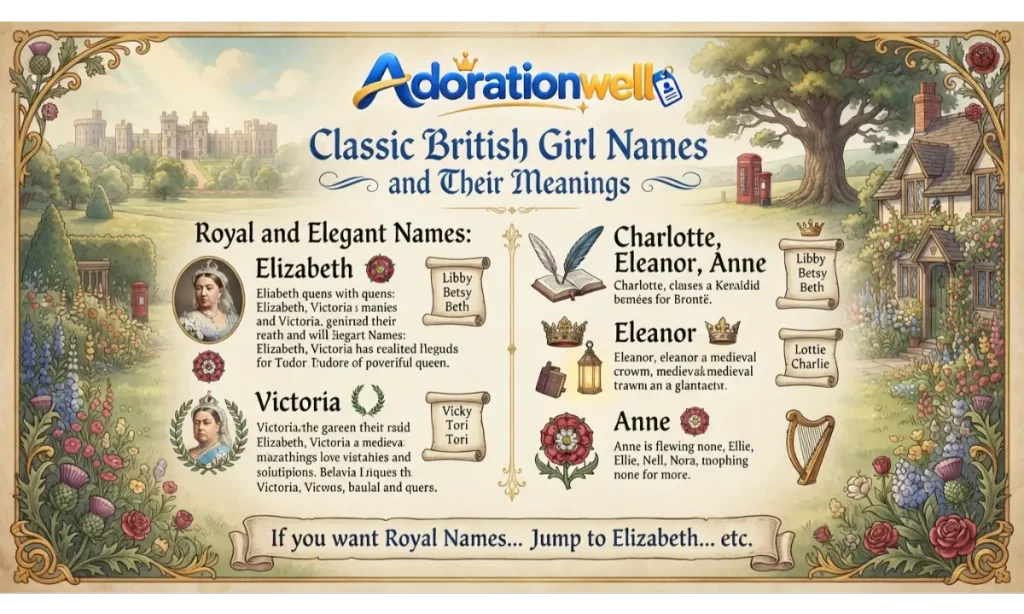
Searching for nice English names for girls? Classic British names meanings for girls range from queenly to cottage-garden sweet. Many of them also come with lovely nicknames, so you get two names in one. Every pick keeps classic British names meanings simple to say, spell, and love.
Royal and Elegant Names
Queens, princesses, and noblewomen have shaped this group. Classic British names meanings here feel graceful without being fussy.
Elizabeth
Elizabeth comes from Hebrew and means “God is my oath.” Elizabeth I ruled from 1558 to 1603. Elizabeth II reigned for 70 years, which is why many people call it the most British girl name. Libby, Betsy, and Beth all work.
Victoria
Victoria is Latin for “victory.” Queen Victoria reigned from 1837 to 1901 and gave her name to an entire era. Vicky and Tori feel casual, while the full name still sounds regal.
Charlotte
Charlotte is the French feminine form of Charles and means “free person.” Novelist Charlotte Brontë gave it literary weight. Princess Charlotte, born in 2015, renewed its royal link. Lottie and Charlie are favorite short forms.
Eleanor
Eleanor is often linked to the word “light.” Eleanor of Aquitaine married Henry II in 1152 and became one of medieval Europe’s most powerful queens. Ellie, Nell, and Nora all grow from it.
Anne
Anne comes from Hebrew and means “grace.” Queen Anne ruled from 1702 to 1714, and Anne Boleyn remains one of the most famous Tudor figures. Its short, simple shape feels timeless and polished.
Read More: 110+Baby Names That Mean Blessing: The Complete Guide for Girls and Boys
Vintage Charm Names
Think lace curtains and library shelves. Classic British names meanings in this group were popular a century ago, and now they’re returning. Many of these classic British names meanings feel fresh again.
Beatrice
Beatrice is Latin for “she who brings happiness.” Shakespeare gave the name a sparkling heroine in Much Ado About Nothing. Princess Beatrice, born in 1988, is a modern royal namesake. Bea and Trixie are sweet nicknames.
Harriet
Harriet is a feminine form of Harry, so it also means “home ruler.” Victorian writer Harriet Martineau used her pen to challenge social norms. Hattie and Harry make bright, friendly short forms.
Florence
Florence is Latin for “flourishing.” Nurse Florence Nightingale was born in the Italian city of Florence in 1820 and was named after it. Flo and Florrie bring a playful twist.
Matilda
Matilda means “mighty in battle.” In the twelfth century, Empress Matilda fought to claim the English throne. Roald Dahl’s 1988 novel Matilda gave the name a bookish, clever spirit. Tilly and Mattie are lovely options.
Edith
Edith is Old English for “prosperous in war.” Edith of Wessex was queen to Edward the Confessor. Nurse Edith Cavell, honored for her courage in the First World War, added a modern layer of respect.
Nature and Floral Classics
British gardens have inspired names for centuries. Classic British names meanings drawn from plants feel soft, bright, and easy to love.
Rose
Rose comes from the Latin word for the flower. The Tudor rose became England’s national emblem after the Wars of the Roses. The name is brief and elegant, and it pairs well with almost any middle name.
Lily
Lily comes from Latin lilium and carries a feeling of purity and renewal. It has been a garden favorite in Britain for centuries. The name is gentle and lyrical, and Lils is a ready nickname.
Ivy
Ivy comes from the Old English word for the evergreen climbing plant. The traditional English carol “The Holly and the Ivy” keeps it linked to winter celebrations. It sounds crisp and very current.
Violet
Violet traces to the small purple flower and the Latin word viola. It was popular in Victorian nurseries and feels richly vintage now. Vi and Vivi make cozy short forms.
Daisy
Daisy means “day’s eye,” because the petals open at dawn. In Britain, it has long served as a pet name for Margaret. The sound is sunny and relaxed.
Soft Traditional Names
These names have gentle sounds and deep roots. Classic British names meanings here feel reassuring, as if the name already knows your child.
Amelia
Amelia comes from a Germanic word meaning “work,” so it signals someone industrious. Henry Fielding titled a 1751 novel Amelia, which cemented its place in English fiction. Millie and Mia are natural short forms.
Alice
Alice comes from an old Germanic name that means “noble.” Lewis Carroll published Alice’s Adventures in Wonderland in 1865, inspired by a young Oxford girl named Alice Liddell. Allie makes a friendly nickname.
Penelope
Penelope is a Greek name often linked to “weaver.” In Homer’s Odyssey, it belongs to the patient wife of Odysseus. Novelist Penelope Fitzgerald won the Booker Prize in 1979. Pen and Nell are lovely short forms.
Margaret
Margaret comes from the Greek word for “pearl.” St. Margaret of Scotland lived in the eleventh century, and Margaret Thatcher became the first female British prime minister in 1979. Maggie, Peggy, and Daisy are all traditional nicknames.
Lucy
Lucy is Latin for “light.” C. S. Lewis chose it for Lucy Pevensie, the brave youngest child in The Lion, the Witch and the Wardrobe. It sounds fresh and a little bookish, and Lulu is a sweet variation.
Naming tip: If you love a vintage girl name, check its nicknames before you commit. Classic British names meanings often come with two or three friendly short forms, which gives your child options as she grows.
Classic British Unisex Names and Their Meanings
Gender-neutral names are not a new idea. Several classic British names meanings have served boys and girls for generations, often because they began as surnames or place names.
Morgan
Morgan is Welsh and is usually read as “sea-born” or “bright sea.” In Arthurian legend, the sorceress Morgan le Fay carries the name. In Wales today, it is used for both boys and girls.
Robin
Robin began as a pet form of Robert, which means “bright fame.” The legendary outlaw Robin Hood made it famous. The little red-breasted bird adds a cheerful, wintry image.
Rowan
Rowan has two roots. It can mean “little red-haired one” in Gaelic, and it also names the rowan tree. British folklore treated rowan branches as protection against witches.
Ashley
Ashley is an Old English place name meaning “ash tree clearing.” It began as a surname and later moved into first-name use. The soft sound suits many families and works for any child.
Lindsay
Lindsay comes from the Old English region of Lindsey, which means “Lincoln’s island.” Scottish clan Lindsay helped spread it across the Lowlands. Today it feels easygoing and friendly.
Alex
Alex is short for Alexander or Alexandra and means “defender of people.” Scottish scientist Alexander Fleming discovered penicillin in 1928. Queen Alexandra, wife of Edward VII, gave the long form a royal feel.
These classic British names meanings show how place names and nature words slip easily across genders.
Traditional British Names From the 1800s
Searching for English male names from the 1800s? Queen Victoria reigned from 1837 to 1901, and Victorian classic British names meanings are enjoying a comeback. Many of these names feel old-fashioned in the best way.
Victorian-Era Boy Names
Victorian boys’ names sound dapper, a little formal, and full of character. Classic British names meanings from this period often honor royalty or literature.
Albert
Albert means “noble and bright.” Prince Albert, Queen Victoria’s husband, made the name popular across Britain. London’s Royal Albert Hall was dedicated to his memory. Bertie and Al are friendly short forms.
Ernest
Ernest means “serious” or “determined.” Oscar Wilde’s 1895 play The Importance of Being Earnest delighted audiences with a pun on the name. Ernie gives it a sweet, modern twist.
Herbert
Herbert is Germanic for “army bright.” Herbert Asquith led the country as prime minister from 1908 to 1916. Bertie and Herb are easy nicknames that soften the formal feel.
Percy
Percy comes from a Norman family who took their name from Perci in Normandy. Poet Percy Bysshe Shelley made it a Romantic favorite. It sounds playful and gentle, which suits a bright little boy.
Victorian-Era Girl Names
Girls’ names from this era feel soft and lyrical. Classic British names meanings here are quietly stylish.
Ada
Ada comes from an old Germanic word meaning “noble.” Ada Lovelace, born in 1815, wrote early notes on Charles Babbage’s Analytical Engine. Many people call her a pioneer of computing. Short and bright, Ada is easy to love.
Mabel
Mabel began as a short form of Amabel, which comes from a Latin word meaning “lovable.” The name was a favorite in late Victorian nurseries. Its sweet, old-world sound is turning heads again.
Agnes
Agnes comes from a Greek word for “pure.” Anne Brontë named her 1847 novel Agnes Grey after its quiet, determined heroine. Aggie and Nessie are charming nicknames.
Ethel
Ethel is a short form of old English names that began with the word for “noble.” Composer and suffragette Ethel Smyth composed boldly and campaigned for women’s votes. Effie is a delightful nickname.
Naming tip: Victorian classic British names meanings often come with built-in nicknames like Bertie, Effie, and Ernie. They keep the old-fashioned feel warm.
Welsh and Scottish Classics Within British Tradition
Britain’s classic names don’t stop at England’s borders. Classic British names meanings from Wales and Scotland add music, mountains, and a bit of mist. Here are eight that fit the classic mold.
Rhys
Rhys is Welsh and means “ardor” or “enthusiasm.” The twelfth-century ruler Rhys ap Gruffydd, known as the Lord Rhys, led much of south Wales. The name sounds crisp and modern.
Owen
Owen likely means “young warrior.” Owain Glyndŵr led a major Welsh revolt against English rule around 1400, making the name a symbol of Welsh pride. It’s friendly, strong, and easy to spell.
Gwen
Gwen means “white” or “blessed” in Welsh. Painter Gwen John, born in Wales, became admired for her quiet portraits. The name is short, graceful, and just right as a standalone or a short form of Gwendolyn.
Bronwen
Bronwen is often explained as “white breast,” a poetic Welsh description of fairness. It has an old, musical rhythm. Bron and Wenna make easier nicknames for everyday use.
Angus
Angus comes from the Gaelic name Aonghus and is usually explained as “one strength.” It is also the name of a Scottish county. The sound is strong, warm, and a little rugged.
Callum
Callum comes from Columba, a Latin word for “dove.” St. Columba founded a monastery on the island of Iona in 563. Callum is friendly and approachable, with a distinctly Scottish ring.
Isla
Isla is pronounced EYE-la. It comes from Islay, the Scottish island and river name. Isla Fisher is a well-known bearer. The name is breezy and short, with a gentle sea-air feel.
Fiona
Fiona comes from the Gaelic word for “fair” or “white.” Scottish writer James Macpherson helped popularize it in the eighteenth century. It sounds bright and elegant, with Fi as a friendly short form.
Together, these classic British names meanings show how much music the Celtic nations add to British naming tradition.
Classic British Names Meanings at a Glance
Need a fast comparison? This table puts ten favorites side by side. It shows how classic British names meanings connect to their roots and everyday nicknames.
| Name | Meaning | Origin | Common Nicknames |
|---|---|---|---|
| William | Resolute protector | Germanic via Norman French | Will, Billy, Liam |
| Henry | Home ruler | Germanic via Norman French | Harry, Hal |
| George | Farmer | Greek | Georgie |
| Oliver | Olive tree | Latin via Old French | Ollie |
| Archie | Genuine, bold | Germanic | Arch |
| Elizabeth | God is my oath | Hebrew | Libby, Betsy, Beth |
| Charlotte | Free person | French | Lottie, Charlie |
| Alice | Noble | Old French from Germanic | Allie |
| Florence | Flourishing | Latin | Flo, Florrie |
| Lucy | Light | Latin | Lulu |
A pattern shows up here. Most classic British names meanings tie to virtues such as protection, peace, and light. Many also arrived from other languages and became British through use. Use this table as a starting point whenever you compare classic British names meanings.
How to Choose a Classic British Name
A long list can feel overwhelming. A few simple checks can help you narrow it down. These steps keep classic British names meanings practical rather than purely poetic.
Nicknames and Short Forms
Most classic names come with built-in nicknames. That’s a quiet advantage with classic British names meanings, since your child can pick the version that fits. A few favorites:
- William: Will, Billy
- Elizabeth: Libby, Beth
- Margaret: Maggie, Daisy
- Charlotte: Lottie
- Frederick: Freddie
- Florence: Flo
Think about whether you like the nicknames before you decide. When you study classic British names meanings, the short forms often change how a name feels day to day.
Pairing With Middle Names and Siblings
Pairing is about rhythm, even with classic British names meanings that sound perfect alone. If the first name is long, a short middle name keeps it balanced. For a short first name, a longer middle name adds grace.
Here are a few quick checks:
- Say it aloud. Read the full name with your surname several times.
- Watch the endings. Avoid a first name that ends with the same sound your surname starts with.
- Check the initials. Make sure they don’t spell something awkward.
- Match the style. Sibling sets like Henry and Edith or Oliver and Florence feel united without matching.
You can mix eras too. Classic British names meanings from different periods blend well, such as a royal first name with a floral middle name.
Naming tip: Write your top five names on paper and read their classic British names meanings one more time. The one you keep returning to is usually the winner.
Frequently Asked Questions
What makes a British first name “classic”?
A classic name stays in steady use across generations and ties to British history, language, or culture. Classic British names meanings often link to monarchs, saints, writers, or places, and they rarely rise and fall with trends.
Are classic British names still popular for modern babies?
Yes. Many parents choose them for their familiar sound and lasting style. Names such as Oliver, Charlotte, Henry, Alice, and Florence still appear regularly in UK baby-name lists, and classic British names meanings add a personal reason to pick them.
Do classic British names have specific origins?
Most come from Old English, Norman French, Latin, Hebrew, Greek, or Celtic languages. That mix reflects Britain’s history of settlers, invaders, and trade, so classic British names meanings often reveal where a name first traveled from.
How can I choose a classic name that feels personal?
Focus on meaning, sound, and family connection. Some parents honor a relative, while others pick a name tied to a value they love. Reading classic British names meanings side by side makes the choice clearer.
Are classic names better for formal or everyday use?
They work well in both settings. A full name like Elizabeth suits formal moments, and a short form like Libby feels relaxed. Classic British names meanings stay the same either way, so your child can use whichever version fits.
Do classic British names work well with modern middle names?
Yes. Their balanced rhythm pairs easily with short, long, or modern middle names, such as Henry Jude or Florence Sky. Classic British names meanings give the first name a steady anchor.
What is the most British name for a girl?
Elizabeth is often named the most British girl name because of its royal history. Charlotte, Victoria, Alice, and Florence are also strong contenders, and classic British names meanings can help you choose among them.
Final Thoughts
Classic British names meanings do more than explain a word. They link your baby to kings, poets, and gardens. Every name here comes with a story worth telling, from regal Henry to vintage Florence and Welsh Rhys.
Narrow your list to three. Check the nicknames, then say each full name aloud with your surname. Keep these classic British names meanings handy as you decide. With so many to choose from, your family’s perfect name is probably already on this list.