

You’ve probably heard a name at a wedding or read one in a period drama and thought, “Now that sounds like it belongs in a manor house.” Maybe you’re naming a baby. Maybe you’re writing a character. Or maybe you just love how names like Araminta and Tarquin roll off the tongue.
This guide collects posh British names in one place, with the meaning and a real historical detail for each. You’ll find royal favourites, old money classics, Norman surnames and some wonderfully rare picks. Use it as inspiration, not as a rulebook.
Quick Answer: Posh British names are names linked to royalty, the aristocracy and old landed families. Examples include Arabella, Octavia and Beatrice for girls, and Rupert, Hugo and Montague for boys. They often come from Norman surnames, Latin and Greek revivals, or repeated royal names such as Charles and George.
What Makes Posh British Names Different?
“Posh” isn’t a scientific label. It’s a cultural association, a shorthand for a naming style rather than a measure of anyone’s worth. Some people love the word and others wince at it.
Still, posh British names share a few habits:
- Royal repetition. Families reuse the same names for generations, like Charles, George and Elizabeth.
- Norman roots. Many surnames arrived after 1066 and later became first names.
- A classical education. Greek and Roman names such as Octavia and Augustus signal a taste for history and literature.
- Land and estates. Place names and family surnames pass down as first or middle names.
Here’s the twist. The poshest families often choose the most ordinary names. Nameberry notes that Charles, William, Catherine, George and Charlotte sit among the classics of the British upper classes. The rare, ornate names get the attention, but the royal standards do the quiet work.
Posh Girl Names in the UK
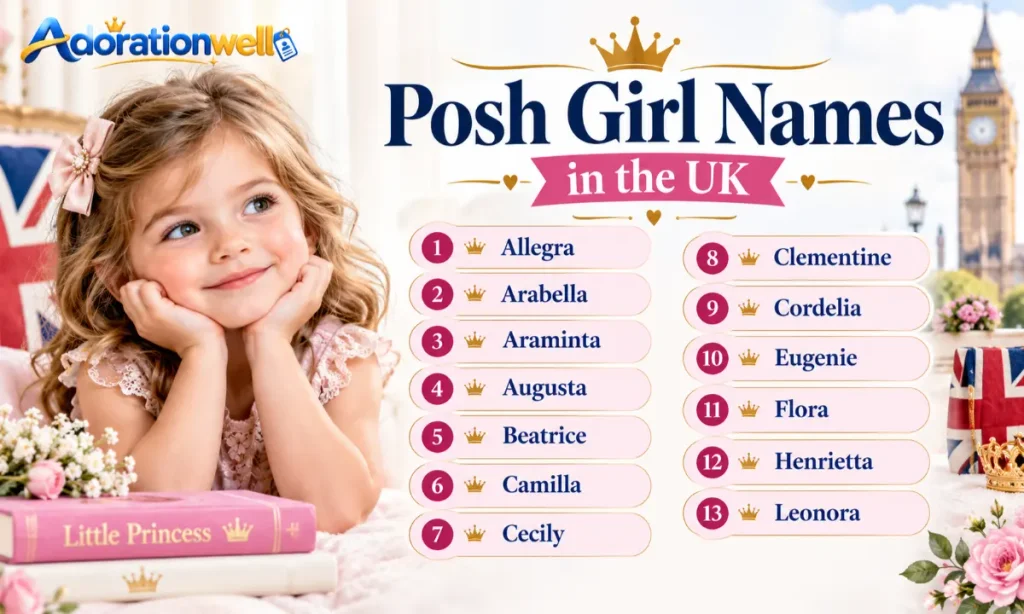
Posh girl names in the UK tend to be long, melodic and full of history. Many come from royal households, Shakespeare’s plays or Latin and Greek roots. Others come from old estate families and Victorian novels.
Top 20 Posh Girl Names
These 20 come up again and again in aristocratic and royal circles:
- Allegra
- Arabella
- Araminta
- Augusta
- Beatrice
- Camilla
- Cecily
- Clementine
- Cordelia
- Eugenie
- Flora
- Henrietta
- Leonora
- Octavia
- Ophelia
- Ottilie
- Primrose
- Rosamund
- Theodora
- Xanthe
Full List with Origins and Aristocratic Signals
| Name | Origin & Meaning | Why It Feels Posh |
|---|---|---|
| Allegra | Italian, “cheerful” | Lord Byron gave it to his daughter Allegra in 1817. Ever since, it’s carried a bohemian, well-travelled air. |
| Antonia | Latin, from the Roman family name Antonius | Historian Lady Antonia Fraser, daughter of an earl, is its best-known modern bearer. The name sounds formal, grown-up and quietly confident. |
| Arabella | Likely a Scottish form of Annabel | The Telegraph birth pages love it. Nameberry cites the triple-barrelled Arabella Clementine Athena as a typical announcement. |
| Araminta | A literary name from the 1600s and 1700s; the meaning is debated | Playwright Sir John Vanbrugh used it in his 1705 comedy The Confederacy. It’s long, musical and gloriously rare. |
| Artemis | Greek, goddess of the hunt and the moon | Myth-based names hint at a classics-heavy education. Artemis is short, bold and one of few on this list that also feels modern. |
| Augusta | Latin, “venerable” | Ada Lovelace was born Augusta Ada Byron, named after her father’s half-sister. Gus and Aggie are the cheerful short forms. |
| Beatrice | Latin, “she who brings happiness” | Princess Beatrice, born in 1988, keeps it in royal view. Shakespeare also gave it to the sharp-witted heroine of Much Ado About Nothing. |
| Camilla | Latin, a warrior maiden in Virgil’s Aeneid | Queen Camilla made the name instantly familiar. It’s still uncommon enough to feel distinctive, and Milly softens it nicely. |
| Cecily | Latin, from Saint Cecilia, patron saint of music | Oscar Wilde’s Cecily Cardew in The Importance of Being Earnest is the classic literary bearer. It feels soft, old-fashioned and very English. |
| Clarissa | Latin, “bright” or “famous” | Samuel Richardson’s 1748 novel Clarissa gave the name a genteel gloss. It has Georgian polish in three graceful syllables. |
| Clementine | Latin, “merciful” | Clementine Churchill, Winston’s wife, made it a byword for quiet strength. Clemmie and Clem are the usual nicknames. |
| Cordelia | Origin debated, possibly Celtic or Latin | King Lear’s honest youngest daughter carries it in Shakespeare. It has literary weight without feeling showy. |
| Cosima | Greek, from kosmos, “order” or “beauty” | Cosima Wagner, wife of the composer Richard Wagner, was Franz Liszt’s daughter. It suits families with a taste for music and continental culture. |
| Eugenie | Greek, “well-born” | Princess Eugenie of York, born in 1990, brought it back into the royal fold. Few posh names are this literal about their meaning. |
| Flora | Latin, Roman goddess of flowers | Flora MacDonald helped Bonnie Prince Charlie escape after Culloden in 1746. It’s a Telegraph regular, given to three girls in Nameberry’s yearly count. |
| Helena | Greek, “torch” | Saint Helena, mother of Emperor Constantine, gives it early religious weight. Shakespeare also used it for characters in two different plays. |
| Henrietta | Feminine form of Henri, “ruler of the home” | It reached England with Henrietta Maria, the French queen of Charles I. Hattie and Etta are the charming short forms. |
| Iona | Scottish, after the Hebridean island | Saint Columba founded a monastery on Iona in 563. The name feels Celtic, restrained and lightly romantic. |
| Isabella | Medieval Spanish form of Elizabeth | Isabella of France, wife of Edward II, was an English queen consort. It’s a classic with royal depth, though far more common than most names here. |
| Jemima | Hebrew, “dove” | Beatrix Potter’s Jemima Puddle-Duck (1908) gave it a cosy country charm. It’s been a gentry favourite for a long time. |
| Leonora | Italian form of Eleanor | Beethoven’s opera Fidelio has a heroine named Leonore. The name has an operatic swing and a continental flavour. |
| Lettice | Medieval English, from Latin laetitia, “joy” | Lettice Knollys, Countess of Leicester, was Elizabeth I’s cousin and a rival at court. It’s rare, Tudor and guaranteed to turn heads. |
| Marina | Latin, “of the sea” | Princess Marina of Greece married the Duke of Kent in 1934. It’s elegant, easy to say and quietly regal. |
| Miranda | Latin, “admirable” | Shakespeare appears to have coined it for The Tempest. It sounds bookish and warm, with little of the stiffness of other posh picks. |
| Octavia | Latin, “eighth” | Octavia Hill helped found the National Trust in 1895. The name signals Roman grandeur and Victorian social conscience. |
| Olympia | Greek, “of Olympus” | Its grand scale suits the style. Olympia is also the name of a famous exhibition hall in west London. |
| Ophelia | Greek, “help” | Hamlet’s tragic Ophelia defines it, and Millais’s Pre-Raphaelite painting of 1851–52 fixed the image. It’s dramatic and romantic. |
| Ottilie | Germanic, “prosperity in battle” | It was the top first name among Telegraph parents in Nameberry’s yearly count, used five times among 151 girls, yet ranked only 69th nationally. |
| Perdita | Latin, “lost” | Shakespeare gave it to the abandoned princess in The Winter’s Tale. It’s poetic, rare and instantly memorable. |
| Primrose | English, from the spring flower | The Primrose family are Earls of Rosebery, and Archibald Primrose served as prime minister in 1894–95. Prim and Rosie are natural nicknames. |
| Rosamund | Old Germanic, “horse protector” (often read as “rose of the world”) | Fair Rosamund Clifford was the legendary mistress of Henry II. The name carries medieval romance. |
| Tatiana | Russian, from the Roman name Tatius | Grand Duchess Tatiana Nikolaevna was one of Tsar Nicholas II’s daughters, so it carries Romanov glamour. |
| Theodora | Greek, “gift of God” | The Byzantine empress Theodora ruled beside Justinian in the sixth century. Thea and Dora keep it wearable today. |
| Xanthe | Greek, “golden” or “yellow” | Tatler reportedly counts it among the poshest girls’ names. It’s pronounced “ZAN-thee”, a tip worth knowing before the school register. |
Popular Nicknames for Posh Female Names
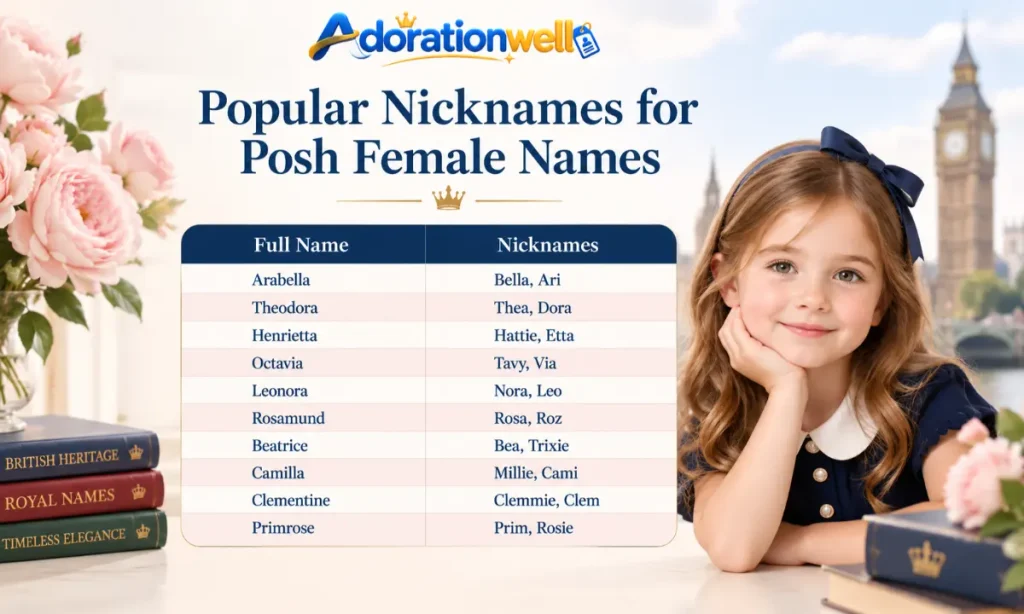
Posh nicknames are half the fun. They shrink a grand name into something friendly.
| Full Name | Nicknames |
|---|---|
| Arabella | Bella, Ari |
| Theodora | Thea, Dora |
| Henrietta | Hattie, Etta |
| Octavia | Tavy, Via |
| Leonora | Nora, Leo |
| Rosamund | Rosa, Roz |
| Beatrice | Bea, Trixie |
| Camilla | Millie, Cami |
| Clementine | Clemmie, Clem |
| Primrose | Prim, Rosie |
Posh Boy Names in Britain
Posh boy names in Britain lean on three sources: Norman French surnames, the peerage and a long line of royal namesakes. Many also come from classical schooling or from old estate families.
Top 20 Posh Boy Names
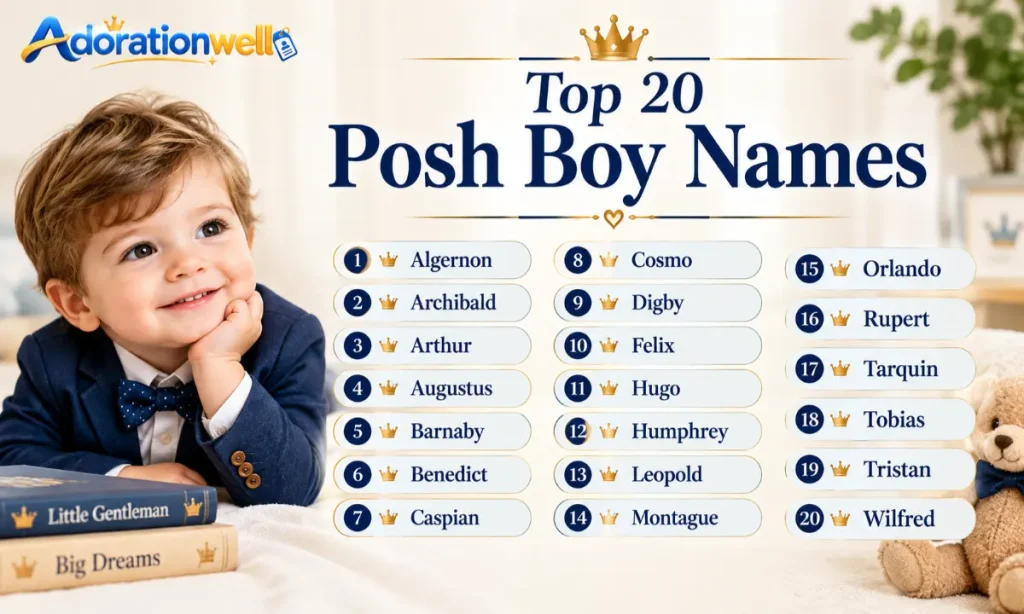
- Algernon
- Archibald
- Arthur
- Augustus
- Barnaby
- Benedict
- Caspian
- Cosmo
- Digby
- Felix
- Hugo
- Humphrey
- Leopold
- Montague
- Orlando
- Rupert
- Tarquin
- Tobias
- Tristan
- Wilfred
Read More: 210+ Anime Girl Names: Cute, Strong, Dark & Japanese Names With Meanings
Full List with Origins and Historical Context
| Name | Origin & Meaning | Why It Feels Posh |
|---|---|---|
| Algernon | Norman French, “with a moustache” | The Percy family, Earls of Northumberland, used it for generations. Oscar Wilde later gave it to a charming idler in The Importance of Being Earnest. |
| Archibald | Germanic, “genuinely bold” | It’s long been tied to Clan Campbell, whose chiefs became Earls and Dukes of Argyll. Archie keeps it friendly today. |
| Arthur | Celtic, meaning uncertain | Prince Arthur was Henry VII’s eldest son, and Arthur Wellesley became Duke of Wellington. Add the legendary king and the name has a great deal of lineage. |
| Augustus | Latin, “venerable” | Augustus FitzRoy, Duke of Grafton, served as prime minister in the late 1760s. Gus gives it a relaxed twist. |
| Barnaby | Aramaic via Barnabas, “son of encouragement” | Dickens made it the title of Barnaby Rudge (1841). It sounds cheerful, slightly rustic and long-established in gentry families. |
| Benedict | Latin, “blessed” | Sixteen popes have taken the name, and Saint Benedict founded Western monasticism. It’s scholarly and warm without being showy. |
| Bertram | Old Germanic, “bright raven” | It came over with the Normans and appears in Shakespeare’s All’s Well That Ends Well. Old-fashioned but sturdy. |
| Caspian | After the Caspian Sea | C.S. Lewis’s Prince Caspian (1951) turned it into a storybook prince’s name. It feels fresh yet grand. |
| Cosmo | Greek, “order” or “beauty” | Cosmo Gordon Lang was Archbishop of Canterbury from 1928 to 1942. It’s got a jaunty, confident ring. |
| Crispin | Latin, “curly-haired” | Saint Crispin’s Day is the feast Shakespeare’s Henry V invokes before Agincourt in 1415. That’s a lot of drama for two syllables. |
| Digby | Old Norse, “farm by the ditch” | The Digby family were Earls of Bristol in the 1600s. It proves a surname can become a first name with real charm. |
| Fabian | Latin, from the Roman family name Fabius | The Fabian Society, founded in 1884, borrowed it from a Roman general famed for patience. It’s rare and subtly intellectual. |
| Felix | Latin, “lucky” | Composer Felix Mendelssohn charmed Queen Victoria and Prince Albert. The name has stayed cheerful and well-mannered. |
| Frederick | Germanic, “peaceful ruler” | Frederick, Prince of Wales, was the father of George III. Nameberry found it tied for third among Telegraph boys’ first names. |
| Giles | Greek via Old French, from Aegidius | Saint Giles is the patron saint of Edinburgh. Architect Giles Gilbert Scott designed the red telephone box. |
| Hector | Greek, “holding fast” | Homer’s Trojan prince is the original bearer. Like other classical names, it hints at a traditional education. |
| Horatio | Latin, from the Roman family name Horatius | Admiral Horatio Nelson, born in 1758, is the name’s great national hero. It has a dashing, swashbuckling sound. |
| Hugo | Germanic, “mind” or “spirit” | Norman nobles carried Hugh and Hugo across the Channel after 1066. Today it feels crisp, continental and quietly stylish. |
| Humphrey | Germanic, roughly “peaceful warrior” | Duke Humfrey’s Library at Oxford honours Humphrey, Duke of Gloucester, a fifteenth-century book collector. It’s plummy in the best way. |
| Inigo | Spanish (Íñigo), linked to Ignatius | Inigo Jones brought classical architecture to Stuart England. The name has felt artistic ever since. |
| Ivo | Germanic, linked to “yew” | Ivo Taillebois, a Norman baron, held Lincolnshire lands recorded in the Domesday Book of 1086. It’s short, sturdy and rare. |
| Jasper | Persian, “treasurer” | Jasper Tudor, Earl of Pembroke, was Henry VII’s uncle and a key figure in the Tudor rise. It’s also a gemstone. |
| Leopold | Germanic, “brave people” | Prince Leopold, Duke of Albany, was Queen Victoria’s youngest son. The name feels stately and Central European. |
| Ludovic | Latinised Louis, “famous warrior” | Broadcaster Ludovic Kennedy wore it with Scottish gentility. Ludo makes it playful. |
| Lysander | Greek, “liberator” | A Spartan admiral bore it first, then Shakespeare gave it to a lover in A Midsummer Night’s Dream. Dramatic and rare. |
| Magnus | Latin, “great” | Saint Magnus, Earl of Orkney, lends his name to the cathedral in Kirkwall. It has a strong Scottish and Norse feel. |
| Marmaduke | Uncertain, possibly an old Celtic name | It’s been a Yorkshire gentry favourite for centuries and sounds gloriously plummy. People tend to love it or flee. |
| Montague | Norman French, “pointed hill” | The Montagu family became Earls of Sandwich. Monty is a jaunty, approachable short form. |
| Orlando | Italian form of Roland | Ariosto’s Orlando Furioso (1516) made it famous, and Virginia Woolf’s Orlando (1928) revived it. Nameberry counts it among names with a high-status air. |
| Piers | Norman French form of Peter, “rock” | Piers Gaveston was Edward II’s favourite, and the medieval poem Piers Plowman keeps the name in literature. |
| Ralph | Old Norse via Norman French, “wolf counsel” | Many upper-class families say it “Rafe”, as the composer Ralph Vaughan Williams did. Pronunciation is part of the code. |
| Rollo | Latinised Norse Hrolf | Rollo was the first ruler of Normandy and an ancestor of William the Conqueror. It’s a direct line to the Norman story. |
| Rufus | Latin, “red-haired” | King William II was nicknamed Rufus. The name still suggests a ginger-haired rascal. |
| Rupert | German form of Ruprecht, “bright fame” | Prince Rupert of the Rhine led Royalist cavalry in the English Civil War. Mumsnet’s ONS-based list put it at 84th for boys. |
| Tarquin | Latin, from the Etruscan Tarquinius | Tarquin the Proud was Rome’s last king. In British comedy, it’s the go-to shorthand for extreme poshness. |
| Tobias | Hebrew, “God is good” | Scottish novelist Tobias Smollett (1721–1771) carried it in the eighteenth century. It sounds polite and bookish. |
| Tristan | Celtic, from Drustan | The Arthurian tale of Tristan and Iseult is one of medieval romance’s great tragedies. |
| Wilfred | Old English, “desiring peace” | Saint Wilfrid of Ripon lived in the seventh century, and poet Wilfred Owen gave the name wartime poignancy. Nameberry lists it among climbers poised for the national top 100. |
Posh Nicknames for Boys
| Full Name | Nickname |
|---|---|
| Archibald | Archie |
| Montague | Monty |
| Ludovic | Ludo |
| Algernon | Algy |
| Augustus | Gus |
| Frederick | Freddie |
| Peregrine | Perry |
| Barnaby | Barney |
| Jonathan | Jonty |
Structural Patterns in Posh Male Names
Look closely and the names group into a few clear families.
- Norman carryovers: Algernon, Montague, Montgomery, Ivo, Humphrey and Rollo all trace back to the Norman arrival.
- Regnal continuity: Arthur, Philip, Albert and Louis echo the royal line, often as middle names.
- Classical education influence: Augustus, Hector, Tarquin and Lysander reflect a schooling steeped in Greek and Latin.
- Surname-as-first-name trend: Digby, Montague and Montgomery began as family names and moved into first-name use.
Posh Surnames Used as First Names
Many posh surnames began as territorial or aristocratic family names in the British peerage. Upper-class families later used them as first or middle names to keep estate ties and heritage visible. Most reflect geography, Norman roots or noble rank, not passing trends.
Double-Barrel Posh Surnames in the UK
Double-barrel names often appear when two families join through marriage. Aristocratic families kept both names to preserve property ties and honour both sides.
| Surname | Background |
|---|---|
| Spencer-Stanhope | A Yorkshire gentry family of Cannon Hall near Barnsley. Elements of it, like Spencer, moved into first-name use. |
| Cavendish-Bentinck | The family name of the Dukes of Portland, joining two famous aristocratic houses. |
| Montagu-Douglas-Scott | The family name of the Dukes of Buccleuch, a three-part surname that’s a mouthful in the most aristocratic way. |
| Wyndham-Quin | The family name of the Earls of Dunraven, combining English and Irish lines. |
| Vane-Tempest | Part of the Londonderry family name Vane-Tempest-Stewart. |
| FitzRoy-Somerset | Lord Raglan of Crimean War fame was born FitzRoy Somerset, a Norman-style “son of” prefix on a royal-adjacent surname. |
| Temple-Nugent | Part of the very long family name of the Dukes of Buckingham and Chandos. |
Estate and Place-Based Posh British Surnames
The Norman feudal system tied land to identity. That’s why so many family names started as estates, castles or counties.
| Surname | Background |
|---|---|
| Windsor | The royal house adopted it in 1917, during the First World War, replacing a German-sounding name. |
| Beaufort | Margaret Beaufort was the mother of Henry VII. The Beauforts later became Dukes of Somerset and Beaufort. |
| Grosvenor | Linked to the Dukes of Westminster and their major London estate. It comes from a Norman word for a chief huntsman. |
| Hastings | Named after the town of the 1066 battle, and used by the Hastings family, Earls of Huntingdon. |
| Courtenay | The Courtenays were Earls of Devon, and the name arrived from France with the Normans. |
| Fairfax | A Yorkshire family of note, including Thomas Fairfax, the Parliamentary general of the Civil War. |
| Cavendish | The family name of the Dukes of Devonshire, who live at Chatsworth. |
| Russell | The family name of the Dukes of Bedford, from a Norman nickname meaning “little red one”. |
Norman-Derived Posh British Surnames
After 1066, Norman French names entered England’s ruling class. Many still show French patterns, including the “Fitz” prefix, from Old French for “son”.
| Surname | Background |
|---|---|
| Percy | A great northern family, the Earls and Dukes of Northumberland, with roots in Normandy. |
| Neville | Richard Neville, Earl of Warwick, was the “Kingmaker” of the Wars of the Roses. |
| Beauchamp | Pronounced “BEE-chum”, and a mark of the medieval Earls of Warwick. It’s a pronunciation quirk that separates insiders from outsiders. |
| Talbot | The Talbots became Earls of Shrewsbury, and the name lives on as a first name and surname. |
| Mowbray | A powerful medieval family, later Dukes of Norfolk, named for Montbray in Normandy. |
| Devereux | Robert Devereux, Earl of Essex, was Elizabeth I’s dashing and doomed favourite. |
| Mortimer | The Mortimers became Earls of March and rose to real power in the fourteenth century. |
| Montgomery | Roger de Montgomery was a leading Norman lord and Earl of Shrewsbury. |
| FitzAlan | The Earls of Arundel, whose “Fitz” prefix means “son of Alan”. |
Why Do Upper-Class Families Reuse Posh British Surnames?
The answer is inheritance. A surname used as a first or middle name keeps a mother’s family, an estate or a title visible across generations. Families with land or titles have strong reasons to preserve those links.
It also solves a practical problem. When two great families merge through marriage, one surname can quietly ride along as a middle name. That’s why Telegraph-style announcements often list a surname as the second name. Nameberry highlights family surnames like Beaumont, Fitzwilliam, Hartley and Kemp as bold but wearable choices.
Old Money British Names
Old money British names stay steady across generations instead of chasing trends. They’re usually simple, historically documented and tied to the royal line. Think of them as the safe, timeless side of posh: less ornate, but every bit as pedigreed.
Traditional British Royal Regnal Names
| Name | Royal Background |
|---|---|
| Charles | From Germanic “free man”. King Charles III carries it now. Nameberry found it the second most popular boys’ first name among Telegraph parents, and the top middle name. |
| William | Germanic, “resolute protector”. William the Conqueror won the crown in 1066, and Prince William carries it today. |
| Henry | Germanic, “ruler of the home”. Eight kings have borne it, and Prince Harry is officially Henry. |
| George | Greek, “farmer”. Six kings called George reigned in Britain. It topped the Telegraph boys’ list, used nine times as a first name. |
| Edward | Old English, “wealthy guardian”. Edward the Confessor gave it early prestige, and Edward VII kept it in fashion. |
| James | Hebrew via Latin, “supplanter”. The Stuart kings made it a royal fixture in both England and Scotland. |
Historic British Royal and Aristocratic Girl Names
| Name | Royal Background |
|---|---|
| Catherine | Greek, “pure”. Catherine of Aragon and the current Princess of Wales carry it, in the spellings Catherine and Kate. |
| Charlotte | French feminine of Charles. Queen Charlotte was the wife of George III, and Princess Charlotte was born in 2015. |
| Elizabeth | Hebrew, “God is my oath”. Elizabeth I and Elizabeth II defined two golden ages. Lilibet is the famous pet form. |
| Victoria | Latin, “victory”. Queen Victoria reigned from 1837 to 1901 and shaped an entire era’s names. |
Posh Middle Names and Full-Name Combinations
In posh families, the middle names do a lot of the work. Grand first names often sit beside simple, classic middle names.
Nameberry found Rose to be the top middle name for girls in Telegraph announcements, used 13 times but never as a first name, with Mary second. For boys, Charles led as a middle name, followed by David, James and Peter. Nameberry
Here are some sample combinations to show how it works:
- Octavia Rose Beaufort
- Theodora Mary Cavendish
- Clementine Rose Fairfax
- Rupert Charles Devereux
- Hugo James Montgomery
- Barnaby Peter Talbot
The formula is simple. Pair one distinctive name with a familiar royal or family name, then finish with a surname.
Ridiculously Posh British Names
Some names go beyond posh and into delightful extravagance. They’re rare, memorable and not for the faint-hearted.
| Name | Origin & Meaning | Why It Stands Out |
|---|---|---|
| Yseult | Old Welsh and Cornish form of Iseult | Tatler reportedly ranks it among the poshest girls’ names. It comes from the Arthurian romance of Tristan. |
| Xerxes | Persian, from a royal title | The name of the great Persian king. Tatler reportedly lists it among the poshest boys’ names. |
| Ptolemy | Greek, “warlike” | It belongs to the Egyptian dynasty and to the astronomer Ptolemy. The silent P adds to the mystique. |
| Peregrine | Latin, “traveller” or “pilgrim” | It’s also a falcon, which gives it a sleek, adventurous edge. Perry is the friendly short form. |
| Loveday | Cornish English, from a medieval day set aside to settle disputes | It sounds romantic, though the original meaning was about reconciliation. It’s a Cornish gentry classic. |
| Fenella | Scottish Gaelic, “white shoulder” | Sir Walter Scott gave it to a character in Peveril of the Peak. It’s playful and distinctly Scottish. |
| Quentin | Latin, “fifth” | Tatler reportedly includes it among the poshest boys’ names. Sir Walter Scott also wrote a novel called Quentin Durward. |
| Ignatius | Latin, possibly “fiery” | Saint Ignatius of Loyola founded the Jesuits. Nameberry spotted it among the rare Telegraph picks. |
Posh French and Norman-Rooted Names
Many posh British names have French roots. That goes back to the Normans, and to the long habit of aristocrats borrowing continental style.
| Name | Origin & Meaning | Why It Feels Posh |
|---|---|---|
| Delphine | French, “woman from Delphi” | It carries the mystique of Greek oracles, filtered through Parisian elegance. |
| Odette | French, “wealth” | Odette is the enchanted swan princess in the ballet Swan Lake. It’s graceful and theatrical. |
| Genevieve | French, uncertain roots | Saint Geneviève is the patron saint of Paris. The name feels delicate but quietly strong. |
| Margot | French, “pearl” | Dame Margot Fonteyn, the great British ballerina, took it as her stage name. It’s short, chic and timeless. |
| Louis | French, “famous warrior” | Nameberry found Louis tied for third among Telegraph boys’ first names. Prince Louis keeps it royal. |
Unisex Posh British Names
A few posh names have crossed between boys and girls over time. Their history is often surprising.
| Name | Origin & Meaning | Why It Feels Posh |
|---|---|---|
| Evelyn | Norman surname, possibly “hazelnut” | Novelist Evelyn Waugh was a man, yet Evelyn is now mostly a girl’s name. It feels vintage and refined. |
| Vivian | Latin, “alive” | Both a male and female name in Britain. It sounds crisp, literary and slightly mysterious. |
| Hilary | Latin, “cheerful” | It gives its name to the Hilary term at Oxford, and novelist Hilary Mantel made it famous for women. |
| Jocelyn | Norman French, from a Germanic personal name | Traditionally a boy’s name in noble families. Astrophysicist Jocelyn Bell Burnell has made it familiar for women. |
| Sidney | English surname, possibly “wide island” | Poet Sir Philip Sidney and the Sidney family made it aristocratic. It’s often shortened to Sid. |
How to Choose a Posh Name Without Sounding Pretentious
Posh doesn’t have to mean precious. A few simple checks help.
- Say it aloud with your surname. Long names can trip over long surnames.
- Check the nicknames. Arabella becomes Bella and Montague becomes Monty, which keeps things warm.
- Know the story. A name you can explain feels natural, not put on.
- Balance rare with wearable. Pair one grand name with a simple middle, like Rose or James.
- Consider pronunciation. Ralph as “Rafe” or Xanthe as “ZAN-thee” may need a friendly explanation.
FAQs About Posh British Names
What are posh British names?
They’re names historically linked to royalty, the peerage and landed families. Many trace back to Norman surnames, classical revivals or repeated royal names. “Posh” is a cultural association rather than a fixed rule.
What is the poshest British boy or girl name?
There’s no official ranking, and opinions differ. Tatler’s calculations reportedly favour Yseult and Xanthe for girls and Tarquin, Xerxes and Quentin for boys. Royal classics like Charles, George and Beatrice are just as pedigreed.
What are some old money British names?
Old money British names repeat across generations in titled families. Boys’ examples include Edward, Henry and Charles. Girls’ examples include Elizabeth, Catherine and Charlotte. They’re simple, historically documented and tied to the royal line.
Are posh surnames used as first names in the UK?
Yes. Families often use estate or maternal surnames as first or middle names to keep lineage visible. Spencer, Beaufort and Digby are popular examples.
Are royal names always considered posh?
Not always. Royal names like Charles and George often read as posh because of their dynastic use. But popularity, spelling and social context all shape how a name is heard.
Conclusion
Posh British names cover a wide range. There are grand, ornate picks like Araminta and Marmaduke, and there are quiet classics like Henry and Elizabeth. What connects them is history: royal courts, Norman conquests, old estates and a love of literature.
Choose the ones that feel right for you or your character. Say them aloud, learn their stories, and remember that “posh” is a style, not a status. The best name is the one you’ll enjoy saying for years.
[…] 210+ Anime Girl Names: Cute, Strong, Dark & Japanese Names With Meanings 100+ Posh British Names: Old Money, Royal & Aristocratic Names […]
[…] 110+Baby Names That Mean Blessing: The Complete Guide for Girls and Boys 180 Polish Girl Names: Beautiful, Unique & Traditional Names 210+ Anime Girl Names: Cute, Strong, Dark & Japanese Names With Meanings 100+ Posh British Names: Old Money, Royal & Aristocratic Names […]
[…] Read More: 100+ Posh British Names: Old Money, Royal & Aristocratic Names […]