

You want a name with real weight. Maybe you’re naming a baby. Maybe you’re creating a hero for your next story or game. Either way, Anglo-Saxon names with meanings stand out from modern trends. They carry kings, saints, and shield-wall warriors in just a few syllables.
This guide shares 35 Anglo-Saxon names with meanings, plus pronunciation tips, short histories, and modern nicknames. You’ll also find tables for boys, girls, bold picks, and rare gems. Let’s find your favorite.
Quick Answer: Anglo-Saxon names with meanings come from Old English, the language spoken in England from the 5th to the 11th century. Most names join two word-parts, such as æthel (“noble”) and ræd (“counsel”). Alfred, Edward, Edith, and Hilda are the best-known examples.
What Are Anglo-Saxon Names?
Anglo-Saxon names belong to the Angles, Saxons, and Jutes. These Germanic peoples settled in Britain after Roman rule ended. They spoke Old English. That language shaped every name in this guide.
The Anglo-Saxons ruled much of England until 1066. Kingdoms like Wessex, Mercia, Northumbria, and East Anglia produced the kings, queens, and saints behind these names. So when you search for Anglo-Saxon names with meanings, you’re really exploring that world. In practice, “Anglo-Saxon” and “Old English” names are almost the same thing.
How Anglo-Saxon Names Were Built
Most names had two parts. Think of them as building blocks. Ēad (“wealth”) plus weard (“guardian”) gives you Edward. Wulf (“wolf”) plus ric (“ruler”) gives you Wulfric.
Families often reused one block. Alfred the Great’s brothers Æthelbald, Æthelberht, and Æthelred all shared the same opening part. Not every pairing made perfect literal sense. Some simply honored relatives.
That building-block system is why Anglo-Saxon names with meanings read like tiny poems.
Old English Letters You’ll See (Æ, Þ, Ð)
You’ll spot a few unusual letters in this guide. Here’s a quick decoder:
- Æ / æ: sounds like the “a” in cat.
- Þ / þ and Ð / ð: both sound like “th.”
- Ē, ō, ū (with a line above): long vowels.
Modern spellings often swap these for plain letters. Æthelred becomes Ethelred. Once you know the code, Anglo-Saxon names with meanings get much easier to read aloud.
Anglo-Saxon vs. Viking Names
Viking and Anglo-Saxon names can sound alike. Both cultures loved wolves, battle, and rulers. The languages differ though. Anglo-Saxon names come from Old English (Wulfric, Hilda, Edmund). Viking names come from Old Norse (Ragnar, Sigurd, Ivar).
The two worlds also mixed after Danish settlers arrived in northern and eastern England. Harold sits right on the line. It blends Old English here and weald with the Norse Haraldr. If you want pure Anglo-Saxon names with meanings, check the word-parts and not just the sound.
Read More: 110+ Double Barrel Names: Beautiful, Inspiring & Timeless Ideas for Girls, Boys & Unisex
35 Anglo-Saxon Names With Meanings
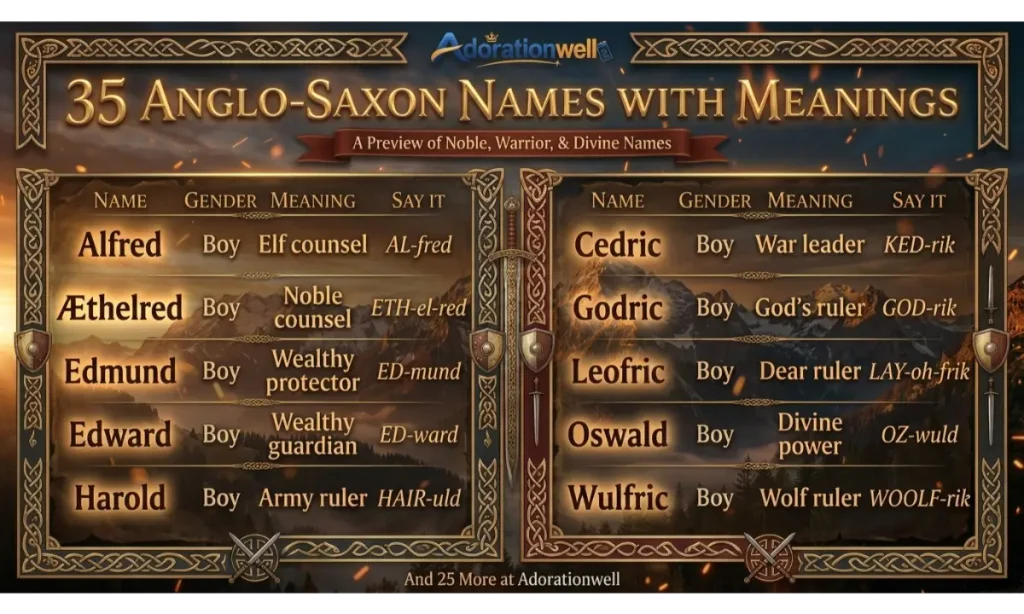
Here are 35 picks, boys first and girls second. Each entry gives you the meaning, the word-parts, and one real story. Pronunciations are approximate because Old English sounded different from modern English. This collection of Anglo-Saxon names with meanings starts with a quick table.
Quick reference: Anglo-Saxon names with meanings at a glance
| Name | Gender | Meaning | Say It |
|---|---|---|---|
| Alfred | Boy | Elf counsel | AL-fred |
| Æthelred | Boy | Noble counsel | ETH-el-red |
| Edmund | Boy | Wealthy protector | ED-mund |
| Edward | Boy | Wealthy guardian | ED-ward |
| Harold | Boy | Army ruler | HAIR-uld |
| Cedric | Boy | War leader (debated) | KED-rik |
| Godric | Boy | God’s ruler | GOD-rik |
| Leofric | Boy | Dear ruler | LAY-oh-frik |
| Oswald | Boy | Divine power | OZ-wuld |
| Wulfric | Boy | Wolf ruler | WOOLF-rik |
| Beorn | Boy | Warrior | BAY-orn |
| Cuthbert | Boy | Famous and bright | KUTH-bert |
| Æthelstan | Boy | Noble stone | ATH-el-stan |
| Edwin | Boy | Wealthy friend | ED-win |
| Godwin | Boy | Good friend | GOD-win |
| Dunstan | Boy | Hill stone | DUN-stan |
| Egbert | Boy | Bright sword | EG-bert |
| Uhtred | Boy | Dawn counsel | OOT-red |
| Æthelflæd | Girl | Noble beauty | ATH-el-flad |
| Edith | Girl | Prosperous in war | EE-dith |
| Eadgifu | Girl | Wealthy gift | ED-yi-foo |
| Ealdgyth | Girl | Old battle | AL-dith |
| Mildred | Girl | Gentle strength | MIL-dred |
| Winifred | Girl | Blessed peace | WIN-i-fred |
| Frideswide | Girl | Strong peace | FRID-es-wide |
| Hilda | Girl | Battle | HIL-da |
| Leofrun | Girl | Beloved secret | LAY-oh-froon |
| Osburh | Girl | Divine fortress | OZ-burk |
| Wulfhild | Girl | Wolf battle | WOOLF-hild |
| Godgifu | Girl | God’s gift | GOD-yi-foo |
| Cyneburh | Girl | Royal fortress | KIN-eh-burk |
| Æthelthryth | Girl | Noble strength | ATH-el-threeth |
| Eadburh | Girl | Wealthy fortress | ED-burk |
| Ælfthryth | Girl | Elf strength | ALF-threeth |
| Wynflæd | Girl | Joy and beauty | WIN-flad |
Alfred
Boy | Meaning: “elf counsel” | Elements: ælf + ræd
No list of Anglo-Saxon names with meanings works without Alfred. King Alfred the Great of Wessex (871–899) held off Viking armies and championed learning in English. Medieval scribes wrote his name Ælfræd. Today, you’ll often hear the friendly short form Alfie.
Æthelred
Boy | Meaning: “noble counsel” | Elements: æthel + ræd
Æthelred II ruled England from 978 to 1016. Later writers nicknamed him “Unready,” from Old English unræd, meaning “poorly advised.” The joke works because his name literally means “noble counsel.” The modern spelling is Ethelred.
Edmund
Boy | Meaning: “wealthy protector” | Elements: ēad + mund
Edmund the Martyr, king of East Anglia, died at Danish hands in 869. Pilgrims honored his shrine. The town of Bury St Edmunds grew up around it. The name feels gentle yet sturdy. Ed and Ned make easy nicknames.
Edward
Boy | Meaning: “wealthy guardian” | Elements: ēad + weard
Edward the Confessor ruled England until 1066 and began rebuilding Westminster Abbey. Before him, Edward the Elder, Alfred’s son, expanded Wessex’s power. The name stayed royal long after the Conquest. Ted, Ned, and Eddie are classic nicknames.
Harold
Boy | Meaning: “army ruler” | Elements: here + weald
Harold Godwinson was the last Anglo-Saxon king of England. He reigned for only a few months in 1066 and fell at the Battle of Hastings. The name also has a Norse cousin, Haraldr, which reflects the era’s mixed cultures.
Cedric
Boy | Meaning: “war leader” (debated)
Here’s a twist. Cedric isn’t a true Anglo-Saxon name. Sir Walter Scott invented it for his 1819 novel Ivanhoe, probably as a misspelling of Cerdic, the legendary founder of Wessex’s royal line. It still feels authentically Saxon. That’s why it earned a spot here.
Godric
Boy | Meaning: “God’s ruler” | Elements: god + ric
Godric pairs a divine idea with a royal one. Saint Godric of Finchale, a hermit born around 1065, helped make it famous. Many readers also know Godric Gryffindor from Harry Potter. It’s rare today but easy to say.
Leofric
Boy | Meaning: “dear ruler” | Elements: leof + ric
Leofric, Earl of Mercia, was among the most powerful nobles under Edward the Confessor. He and his wife Godgifu founded a monastery at Coventry in 1043. The warm leof element makes this name sound both loved and mighty.
Oswald
Boy | Meaning: “divine power” | Elements: ōs + weald
King Oswald of Northumbria ruled from 634 to 642. He invited the monk Aidan from Iona to found the monastery at Lindisfarne. After he died in battle, people honored him as a saint. Ozzy and Oz make the name feel fresh.
Wulfric
Boy | Meaning: “wolf ruler” | Elements: wulf + ric
Wulfric Spot, a wealthy Mercian nobleman, founded Burton Abbey in 1004. His will still survives. In Germanic culture, the wolf stood for fierce loyalty. Wulfric still sounds bold today.
Beorn
Boy | Meaning: “warrior” | Element: beorn
In Old English poetry, beorn meant a warrior or noble man. Many websites say “bear,” but that sense comes from the Norse bjǫrn. Tolkien later gave the name to his bear-shifting character in The Hobbit. Few parents choose it, so it’s nearly one of a kind.
Cuthbert
Boy | Meaning: “famous and bright” | Elements: cūþ + beorht
Saint Cuthbert became bishop of Lindisfarne and died in 687. Later, monks carried his coffin across northern England to escape Viking raids. It finally rested at Durham. Cuthbert shows how Anglo-Saxon names with meanings often tell a saint’s story. Bert and Cuddy are fun nicknames.
Æthelstan
Boy | Meaning: “noble stone” | Elements: æthel + stan
Æthelstan, Alfred’s grandson, became the first king of all England in 927. He won a major victory at Brunanburh in 937. The name blends nobility with granite strength. You’ll also see it spelled Athelstan.
Edwin
Boy | Meaning: “wealthy friend” | Elements: ēad + wine
Edwin of Northumbria ruled from about 616 to 633 and converted to Christianity in 627. Some historians link Edinburgh’s name to his fortress. Edwin stayed in use after the Conquest. Ed and Eddie fit it easily.
Godwin
Boy | Meaning: “good friend” | Elements: gōd + wine
Earl Godwin of Wessex was the most powerful noble in England under Edward the Confessor. His son Harold became king. His daughter Edith became queen. The name feels steady and loyal.
Dunstan
Boy | Meaning: “hill stone” | Elements: dūn + stan
Dunstan served as Archbishop of Canterbury from 959 to 988. He was also a skilled metalworker. Legend says he once grabbed the devil’s nose with hot tongs. The name sounds earthy and rock-solid.
Egbert
Boy | Meaning: “bright sword” | Elements: ecg + beorht
Egbert, king of Wessex from 802 to 839, defeated the Mercians at Ellandun in 825. He was Alfred the Great’s grandfather. The name sounds old-fashioned now. Bert gives it a cozy twist.
Uhtred
Boy | Meaning: “dawn counsel” | Elements: ūht + ræd
Uhtred the Bold governed Northumbria in the early 11th century. Author Bernard Cornwell later gave the name to the hero of The Last Kingdom novels. The first element, ūht, means the dark hour before sunrise. For fans of moody Anglo-Saxon names with meanings, Uhtred is a gem.
Æthelflæd
Girl | Meaning: “noble beauty” | Elements: æthel + flæd
Alfred’s daughter Æthelflæd became Lady of the Mercians after her husband died in 911. She built fortified towns and led armies against the Vikings. Her forces captured Derby in 917. It’s a powerful name for a born leader.
Edith
Girl | Meaning: “prosperous in war” | Elements: ēad + gȳð
Edith of Wessex married Edward the Confessor in 1045. She later commissioned a biography of him, and it survives today. Edith is a graceful example of Anglo-Saxon names with meanings that outlasted 1066. Edie is a sweet modern nickname.
Eadgifu
Girl | Meaning: “wealthy gift” | Elements: ēad + gifu
Eadgifu of Kent was the third wife of Edward the Elder. She became the mother of two kings, Edmund and Eadred. Her name expresses blessing as a gift. Edgiva is an easier modern spelling.
Ealdgyth
Girl | Meaning: “old battle” | Elements: eald + gȳð
Ealdgyth, daughter of Ælfgar of Mercia, married Harold Godwinson in 1066. Before that, she had been married to the Welsh ruler Gruffydd ap Llywelyn. The name sounds quiet but tough. Aldyth is a friendlier spelling.
Mildred
Girl | Meaning: “gentle strength” | Elements: milde + þryð
Saint Mildred, also called Mildrith, led the abbey at Minster-in-Thanet around 700. Her name pairs softness with resilience. It returned to fashion in the late 1800s. Millie is a sunny modern nickname.
Winifred
Girl | Meaning: “blessed peace”
Winifred has two roots. The Welsh Gwenfrewi, a 7th-century saint, gave us the modern spelling. Wynfrith, an Old English name meaning “friend of peace,” was the birth name of Saint Boniface. It’s one of the most interesting Anglo-Saxon names with meanings on this list. Winnie is the cute nickname.
Frideswide
Girl | Meaning: “strong peace” | Elements: friþ + swīþ
Saint Frideswide founded a religious house at Oxford and died around 727. She’s the city’s patron saint. The name sounds calm and firm at once. Frida is a modern shortcut.
Hilda
Girl | Meaning: “battle” | Element: hild
Saint Hilda ran the double monastery at Whitby and hosted the Synod of Whitby in 664. Cædmon, the first named English poet, lived under her care. The name is short and fierce. Hilda suits parents who love vintage names.
Leofrun
Girl | Meaning: “beloved secret” | Elements: leof + rūn
Leofrun is a rarity. Its second part, rūn, means “secret” or “counsel” and is the root of the word “rune.” That gives the name a mysterious ring. If you want one of the most unusual Anglo-Saxon names with meanings, this is it.
Osburh
Girl | Meaning: “divine fortress” | Elements: ōs + burh
Osburh was King Alfred’s mother. The scholar Asser tells a famous story about her. She offered a book of Old English poetry to whichever son learned it first. Alfred won. Among Anglo-Saxon names with meanings, Osburh suits a book lover best.
Wulfhild
Girl | Meaning: “wolf battle” | Elements: wulf + hild
Saint Wulfhild served as abbess of Barking in the late 10th century. Two fierce images, wolf and battle, meet in her name. That makes it a dramatic pick for a child or a character. Wulfhilda is a softer variant.
Godgifu
Girl | Meaning: “God’s gift” | Elements: god + gifu
Godgifu is the real name behind Lady Godiva. She was Leofric’s wife and a generous patron of monasteries. The famous ride through Coventry appears only in sources written long after her death. Godgifu remains a classic among Anglo-Saxon names with meanings. Godiva is the common modern form.
Cyneburh
Girl | Meaning: “royal fortress” | Elements: cyne + burh
Saint Cyneburh, a daughter of King Penda of Mercia, became an abbess at Castor in the 7th century. The name suggests noble protection. Cyneburga is the Latinized form.
Æthelthryth
Girl | Meaning: “noble strength” | Elements: æthel + þryð
Saint Æthelthryth founded the abbey at Ely and died in 679. Her medieval name form, Audrey, is still with us. Even the word “tawdry” traces back to “St Audrey’s lace,” once sold at a fair in her honor. Etheldreda is another variant.
Eadburh
Girl | Meaning: “wealthy fortress” | Elements: ēad + burh
Eadburh of Winchester was a daughter of Edward the Elder who became a nun. People revered her as a saint after her death in 951. The pairing of wealth and fortress sounds protective. Edburga is a gentle modern form.
Ælfthryth
Girl | Meaning: “elf strength” | Elements: ælf + þryð
Ælfthryth married King Edgar around 964. She became queen of England and the mother of King Æthelred II. The name has a magical edge. Elfrida is its familiar Latin-friendly form.
Wynflæd
Girl | Meaning: “joy and beauty” | Elements: wynn + flæd
Wynflæd’s will, written around 950, still survives. It lists books, clothing, and furnishings left to her family. That makes it one of the earliest wills by an English woman. If you love playful Anglo-Saxon names with meanings, try Wynflæd. Wynn works as a short form.
Anglo-Saxon Boy Names
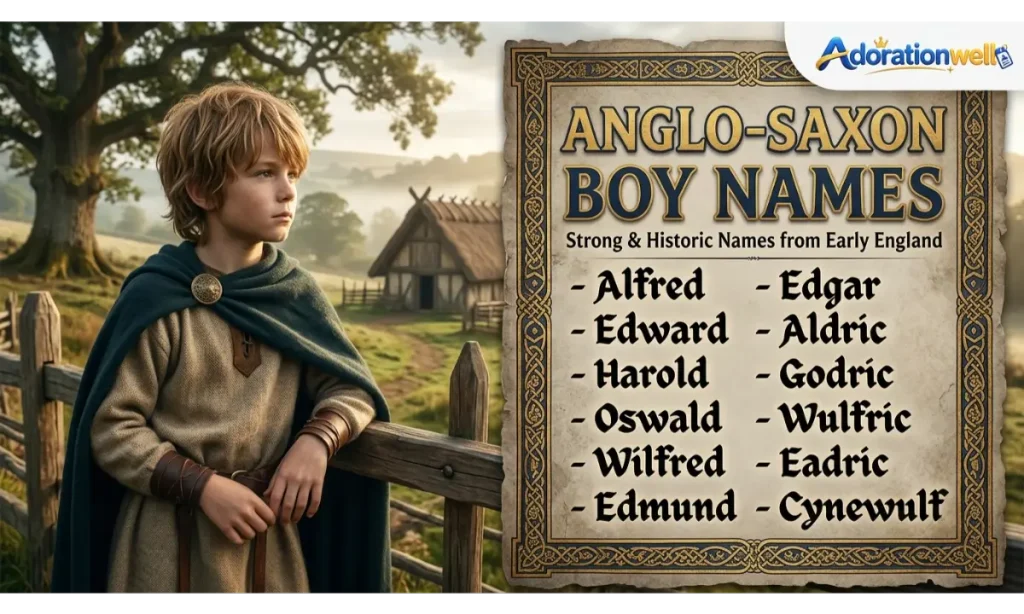
Looking for Anglo-Saxon names with meanings for boys? This table gives you a modern form or nickname for each one. Many shorten easily for everyday use.
| Name | Modern Form or Nickname | Vibe |
|---|---|---|
| Alfred | Alfie, Fred | Wise and warm |
| Æthelred | Ethelred | Noble and rare |
| Edmund | Ed, Ned | Gentle and sturdy |
| Edward | Ted, Eddie | Classic and royal |
| Harold | Harry, Hal | Old-school hero |
| Cedric | Ced | Storybook knight |
| Godric | Rick | Mythic and bold |
| Leofric | Leo | Warm leader |
| Oswald | Ozzy, Oz | Vintage with attitude |
| Wulfric | Wulf | Wild and strong |
| Beorn | Used as is | Legendary |
| Cuthbert | Bert, Cuddy | Scholarly and kind |
| Æthelstan | Athelstan, Stan | Regal |
| Edwin | Ed, Win | Friendly and timeless |
| Godwin | Win | Steady and loyal |
| Dunstan | Dunn | Earthy |
| Egbert | Bert | Quirky and old-fashioned |
| Uhtred | Utred | Moody and heroic |
Most of these Anglo-Saxon names with meanings for boys shorten well, so a formal name can still feel casual.
Read More: 60+ Badass Boy Names With Meanings: Strong, Bold & Powerful Picks
Anglo-Saxon Girl Names
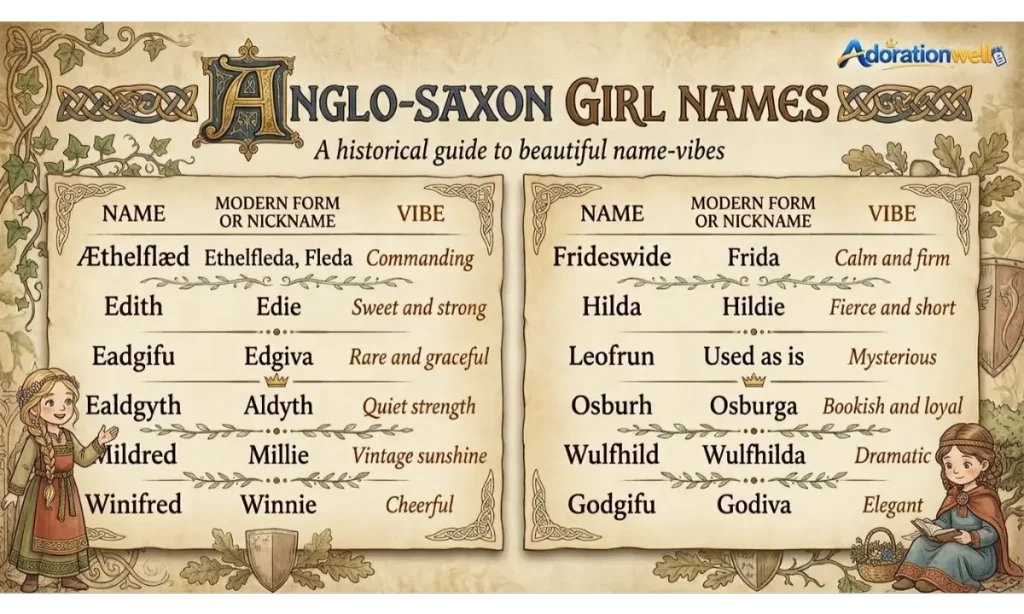
Want Anglo-Saxon names with meanings for girls? Many have lovely Latinized forms that are easier to spell. Here’s your guide.
| Name | Modern Form or Nickname | Vibe |
|---|---|---|
| Æthelflæd | Ethelfleda, Fleda | Commanding |
| Edith | Edie | Sweet and strong |
| Eadgifu | Edgiva | Rare and graceful |
| Ealdgyth | Aldyth | Quiet strength |
| Mildred | Millie | Vintage sunshine |
| Winifred | Winnie | Cheerful |
| Frideswide | Frida | Calm and firm |
| Hilda | Hildie | Fierce and short |
| Leofrun | Used as is | Mysterious |
| Osburh | Osburga | Bookish and loyal |
| Wulfhild | Wulfhilda | Dramatic |
| Godgifu | Godiva | Elegant |
| Cyneburh | Cyneburga | Regal |
| Æthelthryth | Audrey, Etheldreda | Graceful and strong |
| Eadburh | Edburga | Protective |
| Ælfthryth | Elfrida | Magical |
| Wynflæd | Wynn | Playful |
Audrey and Elfrida prove that Anglo-Saxon names with meanings can sound surprisingly modern.
Badass Anglo-Saxon Names With Meanings
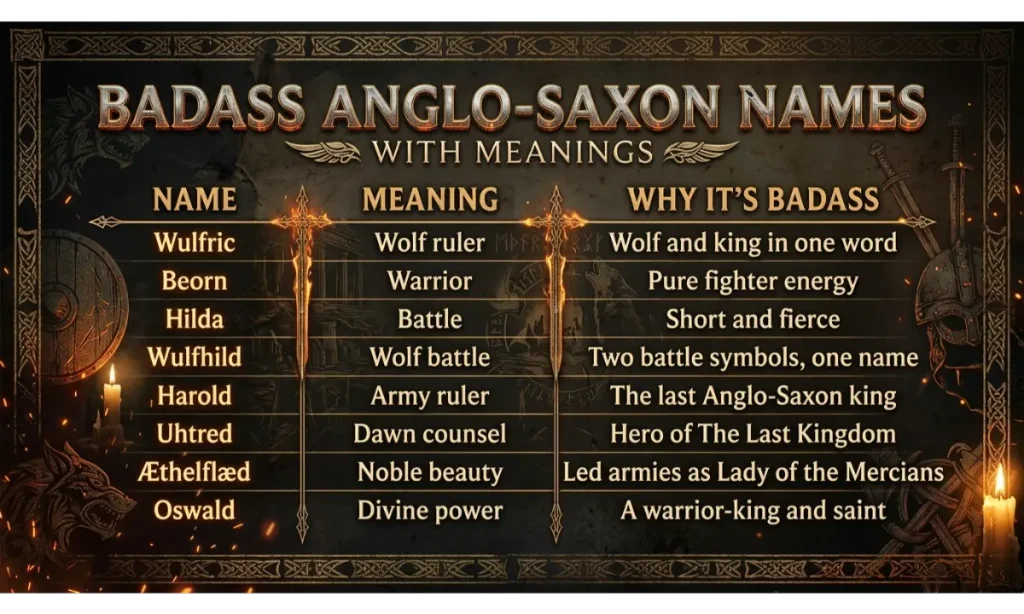
Want something bold? These Anglo-Saxon names with meanings sound like they belong on a battlefield.
| Name | Meaning | Why It’s Badass |
|---|---|---|
| Wulfric | Wolf ruler | Wolf and king in one word |
| Beorn | Warrior | Pure fighter energy |
| Hilda | Battle | Short and fierce |
| Wulfhild | Wolf battle | Two battle symbols, one name |
| Harold | Army ruler | The last Anglo-Saxon king |
| Uhtred | Dawn counsel | Hero of The Last Kingdom |
| Æthelflæd | Noble beauty | Led armies as Lady of the Mercians |
| Oswald | Divine power | A warrior-king and saint |
| Egbert | Bright sword | The sword is right in the name |
Rare Anglo-Saxon Names
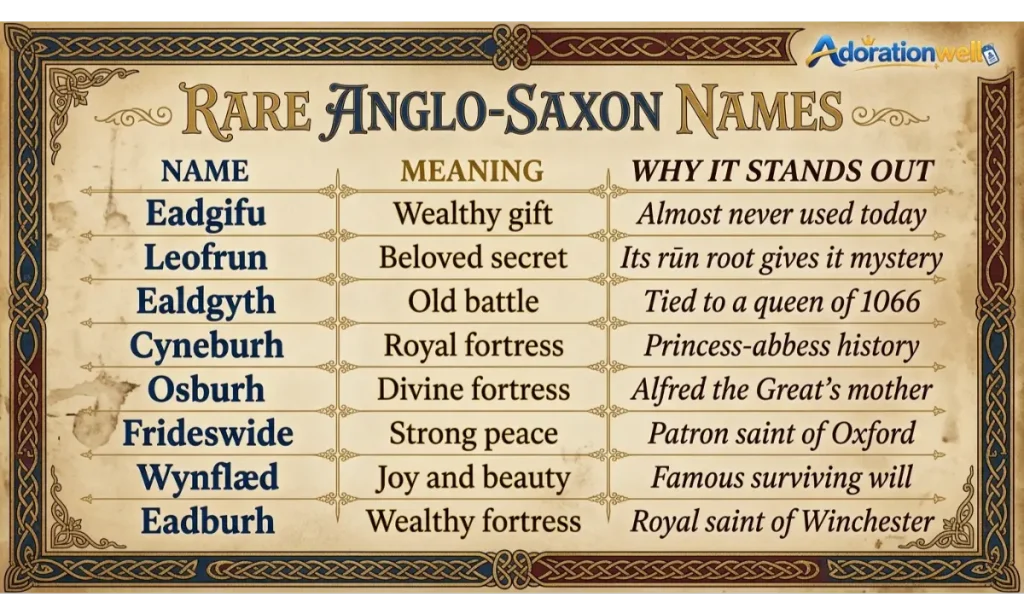
Prefer a name nobody else has? These picks are uncommon today. Each carries real history. Rare Anglo-Saxon names with meanings like these make memorable choices.
| Name | Meaning | Why It Stands Out |
|---|---|---|
| Eadgifu | Wealthy gift | Almost never used today |
| Leofrun | Beloved secret | Its rūn root gives it mystery |
| Ealdgyth | Old battle | Tied to a queen of 1066 |
| Cyneburh | Royal fortress | Princess-abbess history |
| Osburh | Divine fortress | Alfred the Great’s mother |
| Frideswide | Strong peace | Patron saint of Oxford |
| Wynflæd | Joy and beauty | Famous surviving will |
| Eadburh | Wealthy fortress | Royal saint of Winchester |
Common Old English Name Elements and Their Meanings
Learn these building blocks and you can decode almost any entry among Anglo-Saxon names with meanings.
| Element | Meaning | Example Names |
|---|---|---|
| Æthel | Noble | Æthelred, Æthelstan |
| Ēad | Wealth, fortune | Edward, Edmund, Edith |
| Wulf | Wolf | Wulfric, Wulfhild |
| Ric | Ruler, power | Leofric, Godric |
| Hild / Gȳð | Battle | Hilda, Edith |
| Frið | Peace | Frideswide |
| Ræd | Counsel | Alfred, Æthelred |
| Beorht | Bright, famous | Cuthbert, Egbert |
| Leof | Dear, beloved | Leofric, Leofrun |
| Burh | Fortress | Osburh, Cyneburh |
| Weard | Guardian | Edward |
| Mund | Protector | Edmund |
| Stan | Stone | Æthelstan, Dunstan |
| Wine | Friend | Edwin, Godwin |
| Þryð | Strength | Mildred, Ælfthryth |
| Gifu | Gift | Godgifu, Eadgifu |
| Ōs | God, divine | Oswald, Osburh |
| Sige | Victory | Sigeberht |
| Cēne | Bold | Cenwulf |
Mix and match any two, and you’ll see how families built a name like Leofric (“dear” + “ruler”).
Are Anglo-Saxon Names Still Used Today?
Yes, many are. Parents who want historic yet uncommon choices often turn to Anglo-Saxon names with meanings. Alfred, Edward, Edmund, Edith, Hilda, and Mildred all survived. Others changed shape. Godgifu became Godiva. Æthelstan became Athelstan.
Names That Survived the Norman Conquest
After 1066, Norman French names like William and Henry took over. Yet a few Old English names held on. Royal links kept Edward alive. Saints’ cults protected Edmund, Edith, and Cuthbert. Many others, like Wulfric and Leofrun, faded. That’s why so many Anglo-Saxon names with meanings now feel rare and special.
Modern Anglo-Saxon Names for Boys and Girls
Some picks fit easily into today’s nurseries:
- Boys: Alfie (Alfred), Edmund, Edwin, Oswald, Dunstan
- Girls: Edie (Edith), Hilda, Audrey (Æthelthryth), Winnie (Winifred), Elfrida
These are the easiest Anglo-Saxon names with meanings to use in daily life.
Anglo-Saxon Names in Books and TV
Stories keep these names alive. The Last Kingdom features Uhtred, Alfred, and Æthelflæd. Tolkien drew on Old English for the riders of Rohan, with names like Éomer and Éowyn. Harry Potter gave us Godric and Cedric. Fiction is a great way to meet Anglo-Saxon names with meanings.
How to Choose an Anglo-Saxon Name
Picking one can feel tricky. These tips help:
- Say it aloud. Practice the pronunciation with the people who’ll use it most.
- Check the nickname. Alfie, Edie, and Winnie make formal names friendly.
- Simplify the spelling. Ethelred or Athelstan are easier than Æthelred or Æthelstan.
- Match the meaning. Want strength? Try Hilda. Want wisdom? Try Alfred.
- Test it with your surname. Say the full name three times.
Choosing from Anglo-Saxon names with meanings is easier when you start with the quality that moves you. Then pick the one you can say with confidence.
Frequently Asked Questions
What is the most famous Anglo-Saxon name?
Alfred is the most famous of all Anglo-Saxon names with meanings, thanks to Alfred the Great. Edward, Harold, and Edith also rank high.
How were Anglo-Saxon names formed?
Parents joined two Old English word-parts, like æthel and ræd. That’s how Anglo-Saxon names with meanings captured ideas such as “noble counsel” in a single name.
What’s the difference between Anglo-Saxon and Viking names?
Anglo-Saxon names come from Old English. Viking names come from Old Norse. Both groups loved wolf and battle themes. True Anglo-Saxon names with meanings use elements like æthel, ēad, and ric.
Which Anglo-Saxon names are still popular today?
Alfred, Edward, Edmund, Edith, Hilda, and Mildred survived the Conquest and remain in use. Many other Anglo-Saxon names with meanings are rare but easy to revive with a nickname like Alfie or Edie.
What are some good Anglo-Saxon girl names?
Try Edith, Hilda, Mildred, Æthelflæd, or Godgifu (Godiva). Among Anglo-Saxon names with meanings for girls, Hilda (“battle”) and Edith (“prosperous in war”) are the easiest to wear today.
Conclusion
Anglo-Saxon names with meanings do more than label a person. Each one packs a value like strength, peace, or wisdom into a few syllables. Many also come with a real king, queen, or saint behind them.
Start with the meaning that speaks to you. Then check the pronunciation and the nickname. Whether you choose Alfred, Hilda, or a rare gem like Leofrun, you’re picking a name with over a thousand years of history. Among all Anglo-Saxon names with meanings, the best one is the one you’ll say with pride.
[…] Baby Names Meanings: Beautiful, Powerful & Inspiring Names for Girls, Boys & Unisex 35 Anglo-Saxon Names With Meanings: Powerful & Timeless Old English Picks 60 Baby Names That Mean Leader or Protector: Powerful, Strong & Inspiring Picks 110+ […]